Best Running Watches For Marathons in 2026

Most marathon watch guides get one thing completely backwards.

They start with specs. GPS chipsets, battery hours, display types, and a spreadsheet of features you will never use. By the time you finish reading, you are more confused than when you started.

I coach runners. And after fitting dozens of marathoners into the right watch, I can tell you the question that actually matters is simpler than that: what does your training look like, and which Garmin fits it?

This guide is built around how you actually train. Your weekly mileage, your goal finish time, and how deep you want to go into the data. I am going to walk you through the full current Garmin lineup for 2026, tell you honestly which one earns its price tag for your profile, and flag the models that are overkill.

I lean Garmin in this guide because, for marathon training specifically, nothing else touches the ecosystem. Coros has the battery crown and Apple has smartwatch polish, but Garmin Connect plus the Forerunner lineup is still the gold standard for getting to a start line prepared. I will still mention the alternatives where they genuinely win.

Quick Picks at a Glance

If you are in a hurry, start here. These are the four Garmin watches that cover 95 percent of marathoners in 2026, matched to training profile and budget.

Casual · Sub-5

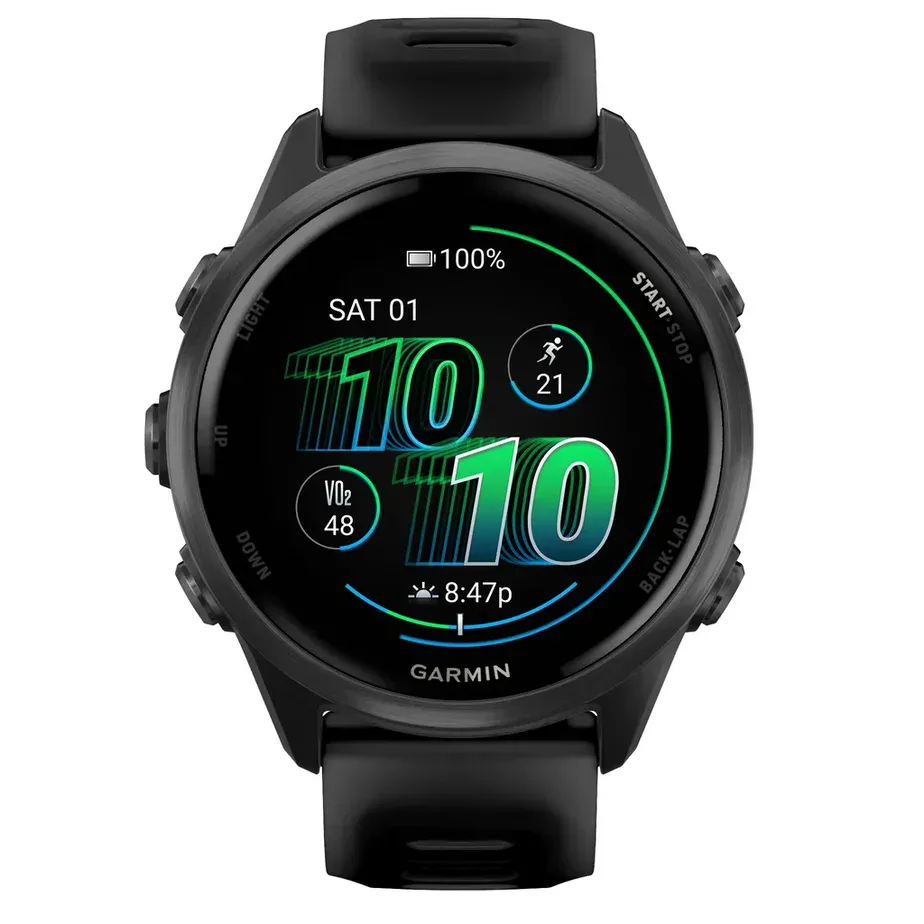
Garmin Forerunner 55

Garmin Forerunner 55 GPS running watch
$199
20 hr GPS · 7-day battery · No-frills reliability
Check Amazon Price
Best Value · Sub-4

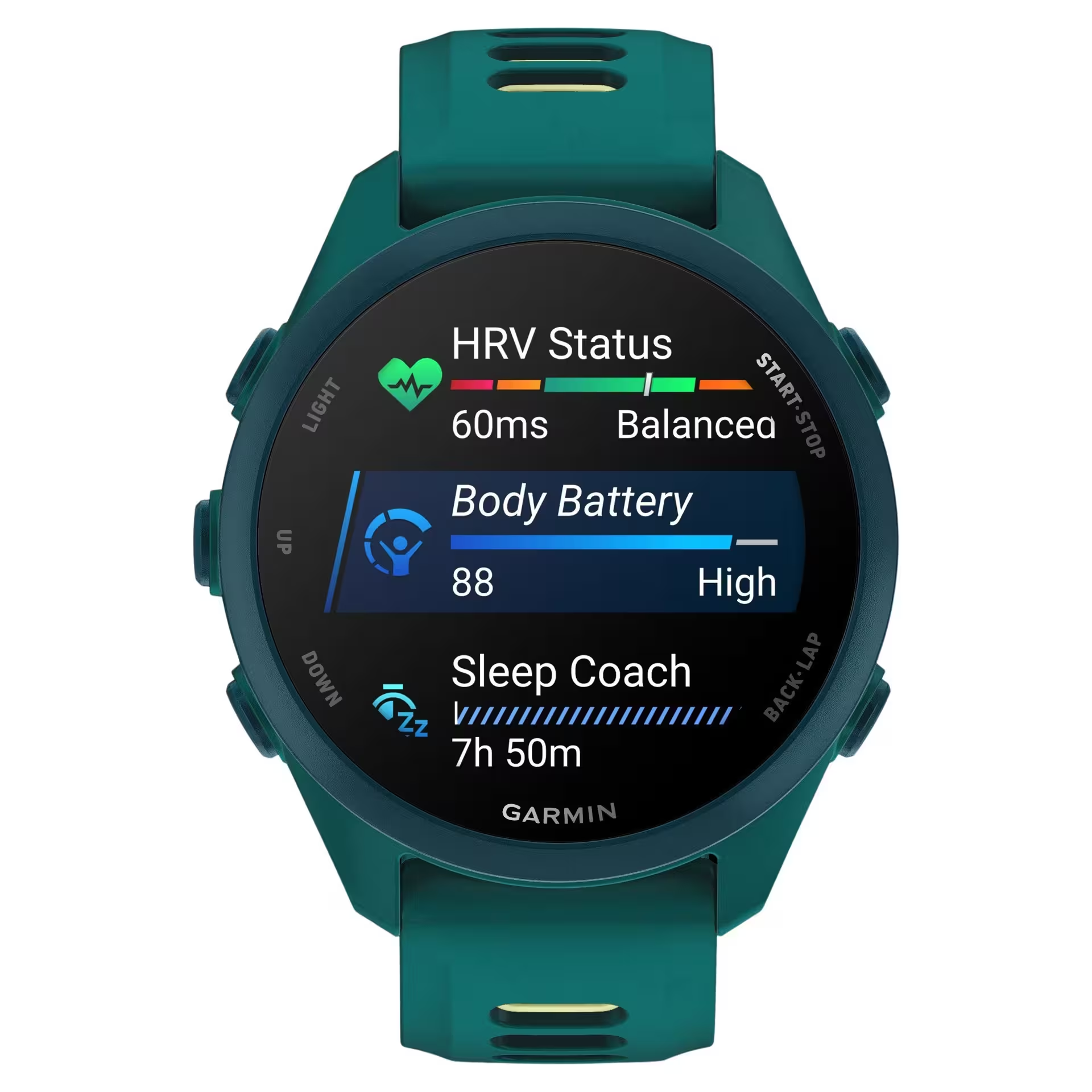
Garmin Forerunner 165

Garmin Forerunner 165 AMOLED running watch
$249
AMOLED · 19 hr GPS · Body Battery · PacePro
Check Amazon Price
Serious · Sub-3:30

Garmin Forerunner 265

Garmin Forerunner 265 with music and GPS
$399
Multi-band GPS · Training Readiness · HRV
Check Amazon Price
Dedicated · Sub-3

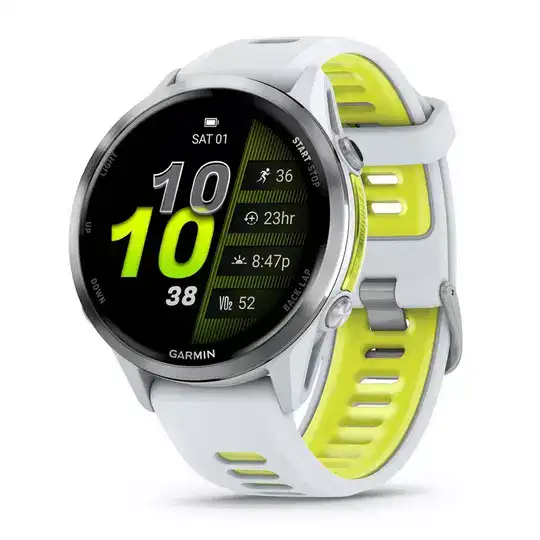
Garmin Forerunner 570

Garmin Forerunner 570 running watch
$549
Elevate Gen5 HR · Triathlon Coach · Skin temp
Check Amazon Price
Not sure which profile you fit into? Take our free Running Watch Finder quiz. 60 seconds and it will point you at the right Garmin.

Pick Your Marathon Watch by Training Profile

Tap the profile that sounds most like you. Each one opens up with what you need, what you do not, and the Garmin that fits.

Profile 1The Casual Marathoner · 20 to 25 mpw · Sub-5 goal

This is you if: You run 3 to 4 times a week. Your long run is the anchor of the week. You are maybe following a free training plan from Nike Run Club, Strava, or a printout from a running magazine. You want to finish strong and feel proud, not chase a PR.

What you need from a watch:

  • Accurate pace and distance for your long runs (the rest of the week, it barely matters)
  • GPS battery that easily outlasts a 4 to 5 hour marathon
  • A simple heart rate zone view so you know when you are pushing too hard
  • Battery that lasts the full week so charging does not become a chore

What you do NOT need:

  • Advanced recovery scores (you will not use them)
  • Multi-band GPS (your city route is fine with standard GPS)
  • Running power, ground contact time, or other dynamics
  • Music storage (your phone is already in your pocket)
Garmin Forerunner 55 running watch on wrist
The Pick: Garmin Forerunner 55 · $199

The Forerunner 55 is the no-nonsense Garmin. It has been out since 2021 and it is genuinely showing its age (no AMOLED, no altimeter), but for a casual marathoner running road routes, it nails the fundamentals. 20 hours of GPS covers even a 5:30 marathon with battery to spare. VO2 Max and a race predictor give you something to track as you build fitness. Pace, distance, heart rate. Done.

Check Amazon Price →

When to skip the 55 and step up: If you are willing to spend another $50, the Forerunner 165 is the better buy in 2026. You get an AMOLED display, altimeter data, and Body Battery. For a casual marathoner it is arguably overkill, but the 165 will age better. Garmin is expected to refresh the 55 in 2026, so if you see one near $150 on sale, grab it. Otherwise the 165 is where most casual runners should land.

Profile 2The Serious Amateur · 25 to 35 mpw · Sub-4 goal

This is you if: You are running 4 to 5 times a week and following a structured plan (Hal Higdon, a coach, a paid training app, or a plan you built yourself). You care about your splits. You do at least one quality workout per week: tempo, intervals, or progression runs. You want to understand whether your training is actually working.

What you need from a watch:

  • Clean display of pace, heart rate, and zone during tempo and interval work
  • Training Effect and Training Load so you know if the week was productive
  • Recovery insight (Body Battery or HRV) to choose between hard and easy days
  • PacePro or similar race pacing tool for long runs and race day
  • Battery that handles your longest run without panic

What you do NOT need:

  • Onboard mapping (you know your routes)
  • Running economy (cool, but chest strap required and the ROI is small)
  • Multisport mode (you are running, not switching to T1)
Garmin Forerunner 165 AMOLED display
The Pick: Garmin Forerunner 165 · $249 to $299

The Forerunner 165 is the single most sensible Garmin purchase in 2026 for marathon runners. An AMOLED display that is actually beautiful, Body Battery, Training Readiness, Sleep Score, PacePro, and Garmin Coach plans are all on board. Battery holds 19 hours in GPS mode (more than enough for any marathon) and 11 days as a smartwatch. You give up multi-band GPS and maps versus the 265 and 570, but for road marathon training, those are not dealbreakers.

Read my full hands-on review: Garmin Forerunner 165 review (tested as a marathoner and triathlete).

Check Amazon Price →
Real runner feedback “The 165 made me take training seriously without taking myself too seriously. Body Battery told me when I was burning the candle at both ends and Training Readiness stopped me running myself into the ground. Hit 3:54 on my second marathon.”

When to step up to the 265: You run urban routes where tall buildings mess with single-band GPS, or you like having music stored on the watch for long runs without a phone.

Profile 3The Dedicated Runner · 35 to 50 mpw · Sub-3 goal

This is you if: You run 6 or 7 days a week. You have a coach, or you are coaching yourself with a proven system like Pfitzinger, Daniels, or Hansons. You have multiple quality workouts per week. Every run has a purpose. You want the data, and more importantly, you will actually use it.

What you need from a watch:

  • Multi-band GPS for accurate splits on any course, city or trail
  • Running Dynamics: cadence, vertical oscillation, ground contact time
  • Lactate Threshold detection to lock in your training paces
  • HRV Status, Training Readiness, and Training Load balance
  • Onboard music for warmup, cooldown, and those days the phone stays home
  • Battery that handles 20-plus mile runs with power to spare
Garmin Forerunner 265 GPS running watch
The Pick: Garmin Forerunner 265 · $399 (often $349 on sale)

In 2026, the 265 is Garmin’s quiet value king. It was the flagship 2xx series watch for two years and the 570 has replaced it on Garmin’s main page, but it is still excellent and you can usually find it discounted. You get the full suite: multi-band GPS, AMOLED, Running Dynamics, Lactate Threshold testing, Training Readiness, HRV Status, music storage, and 20 hours of GPS battery. For a sub-3 hopeful, this watch genuinely helps.

Check Amazon Price →

The newer option to consider: Forerunner 570 at $549. This is the direct successor to the 265, released in 2025. It adds the Elevate Gen5 HR sensor (more accurate wrist HR), skin temperature tracking, Triathlon Coach training plans, AutoLap by timing gates (useful at big marathons like Boston and Chicago), and a brighter AMOLED. Battery is similar at around 18 hours GPS. The upgrade from the 265 to the 570 is meaningful, but not life-changing. If budget is tight, the discounted 265 is still a smart buy. If you want the newest sensors and longest support window, the 570 is the pick.

Honest take If you already own a Forerunner 265, do not upgrade to the 570. The year-over-year improvements are real but incremental. If you are buying your first serious Garmin in 2026, the 570 is the better long-term investment.
Profile 4The Elite Amateur or Ultra · 50+ mpw or ultra training

This is you if: You are chasing a BQ in the 2:40s, running a sub-2:50 open marathon, or you are moving up from road to trail and ultra. You log 50 to 80 miles a week. You use running economy. You care about running tolerance as a training-load safety net. You have a chest strap.

What you need from a watch:

  • The most accurate GPS Garmin makes (multi-band with SatIQ)
  • Full topographic maps for trail, travel, and exploring new routes
  • Running Economy and Running Tolerance (new Garmin metrics that actually help)
  • Battery that laughs at a 50K or a 100K race
  • The full suite: training status, readiness, load ratio, HRV
Garmin Forerunner 970 running watch
The Pick: Garmin Forerunner 970 · $749

The Forerunner 970 is the best pure running watch Garmin has ever made. It replaces the beloved 965 with a sapphire crystal screen (much harder to scratch), a built-in LED flashlight, the brightest AMOLED in the lineup, and two standout new metrics: Running Economy and Running Tolerance. Running Tolerance in particular is a gem. It caps your weekly mileage based on your impact history, which is exactly the safety net serious amateurs need. Battery runs 23 hours in GPS mode and around a week in smartwatch mode.

Check Amazon Price →

The alternative: Garmin Fenix 8 Pro or Enduro 3. If you run more trails than roads, or your goal race is a 50-miler or 100-miler, the Enduro 3 gives you around 60 hours of multi-band GPS battery. The Fenix 8 Pro adds LTE connectivity (no phone needed on long runs) and a tougher case. These are not better running watches than the 970. They are bigger, tougher watches that happen to run really well.

For deep ultra-distance picks, see our full guide: The 5 Best Watches for Ultra-Runners in 2026.

The Full Garmin Marathon Watch Lineup, Explained

Here is the honest breakdown of every Garmin that makes sense for marathon training in 2026. Tap each one to expand.

Garmin Forerunner 55 · The Budget Classic · $199
Garmin Forerunner 55

Who it is for: First-time marathoners on a tight budget who want a real GPS watch without $300+ committed.

What you get: 20-hour GPS battery, 7-day smartwatch battery, basic VO2 Max, race predictor, heart rate zones, and Garmin Coach training plans. Monochrome display, five physical buttons, lightweight 37 gram build.

What you give up: No AMOLED (it is a basic MIP screen), no altimeter or barometer (elevation comes from GPS only, which is less accurate), no multi-band GPS, no music storage, no Body Battery or advanced recovery metrics.

Honest 2026 take: The 55 is pushing five years old and Garmin is widely expected to refresh it in 2026. It is still an excellent starter watch if you find one under $150, but at full price the Forerunner 165 gives you dramatically more value for just $50 more.

Battery: 20 hrs GPS · 14 days smartwatch mode

Garmin Forerunner 165 · The Smart Value Pick · $249 to $299
Garmin Forerunner 165

Who it is for: The majority of marathon runners. Seriously. If you are running 20 to 35 miles a week and you want a watch that looks good, tracks well, and does not require a PhD to understand, this is your Garmin.

What you get: Bright AMOLED touchscreen, Body Battery, Training Readiness, Sleep Score, HRV tracking, PacePro pacing strategy, Garmin Coach plans, altimeter for proper elevation data, a music version if you want phone-free runs, and 19 hours of GPS battery.

What you give up: Single-band GPS only, no full topographic maps, no Running Dynamics like ground contact time, no Lactate Threshold test, no multi-sport triathlon mode.

Honest 2026 take: If you ask me what watch 80 percent of marathoners should buy, it is this one. The tradeoffs are exactly the features most people do not actually use. For a full breakdown, see my Forerunner 165 review.

Battery: 19 hrs GPS · 11 days smartwatch mode

Garmin Forerunner 265 · The Serious Runner Sweet Spot · $399 (often $349 on sale)
Garmin Forerunner 265

Who it is for: Dedicated amateurs chasing BQs, sub-3:30 marathons, or runners who run enough that advanced metrics actually pay off.

What you get: Everything in the 165, plus multi-band GPS (dual frequency for urban and tree cover accuracy), Running Dynamics (cadence, stride, ground contact, vertical oscillation), Lactate Threshold detection, Training Load with focus balance, music storage, and morning reports.

What you give up: No maps (Garmin keeps full topo maps on the 570 and 970), no skin temperature sensor, no flashlight.

Honest 2026 take: Even though the 570 has technically replaced it in Garmin’s lineup, the 265 is still widely available and routinely discounted to $300 to $350. For a sub-3 hopeful who does not need the absolute newest sensors, the 265 at $349 is arguably the best dollar-for-dollar running watch Garmin makes right now.

Battery: 13 hrs multi-band GPS · 20 hrs GPS-only · 13 days smartwatch mode

Garmin Forerunner 570 · The New Mid-Tier Flagship · $549
Garmin Forerunner 570

Who it is for: Runners who want the newest Garmin tech without paying $750, and especially triathletes who want Garmin’s Triathlon Coach plans.

What you get: Everything in the 265 plus the latest Elevate Gen5 optical HR sensor (meaningfully more accurate wrist HR), skin temperature tracking, speaker and microphone for phone calls on your wrist, Garmin Triathlon Coach, AutoLap by timing gates (a huge quality-of-life feature at city marathons where GPS mile markers rarely match the official course), 23 new sport profiles, and a brighter AMOLED.

What you give up: Still no full topographic maps (that is the 970 territory), no flashlight, no sapphire crystal.

Honest 2026 take: The 570 is a legitimate upgrade over the 265, but it is not a must-have if you own a 265 already. If you are coming from a 245, 255, or anything older, the 570 is a big jump. Comes in 42mm and 47mm sizes, which is a win for smaller wrists.

Battery: 11 hrs multi-band GPS · 18 hrs GPS-only · 10 to 11 days smartwatch mode

Garmin Forerunner 970 · The Flagship Runner’s Watch · $749
Garmin Forerunner 970

Who it is for: Serious marathoners, BQ chasers, and ultra runners who want every Garmin running feature in the sleekest package available.

What you get: Titanium bezel, sapphire crystal screen (scratch resistant), built-in LED flashlight, ECG capability, Running Economy (with chest strap), Running Tolerance, full topographic maps, multi-band GPS with SatIQ for battery management, the brightest Garmin AMOLED to date, speaker and mic, music storage, and Garmin Pay.

What you give up: Honestly not much, besides $200 more than the 570. Battery is not as long as the Fenix 8 or Enduro 3. The 47mm case is on the larger side for smaller wrists (no smaller size option).

Honest 2026 take: The 970 is the best running watch you can buy in 2026, period. The new Running Tolerance metric is genuinely useful for preventing the classic marathon buildup mistake of piling up miles too fast. The flip side is the price and the fact that Running Economy requires the $170 Garmin HRM 600 chest strap to unlock fully. If you will not use those two metrics, the 570 gives you 90 percent of the watch for $200 less.

Battery: 15 hrs multi-band GPS · 23 hrs GPS-only · 15 days smartwatch mode

Garmin Fenix 8 Pro and Enduro 3 · For Trail and Ultra · $900+

Who they are for: Trail runners, ultra runners, and athletes who want a rugged multi-sport watch that doubles as a running watch.

Fenix 8 Pro: Full topographic maps, LTE connectivity (leave your phone home on long runs), dive rated, voice notes, mic and speaker, built-in flashlight, and the toughest case Garmin makes. Battery in the 50mm model runs around 30 hours multi-band GPS, 16 days smartwatch.

Enduro 3: Around 60 hours of multi-band GPS battery life, the longest in Garmin’s lineup, solar charging, and a lighter nylon build. Designed for multi-day ultras and expeditions.

Honest 2026 take: For pure marathon training on roads, the Forerunner 970 is the better watch than either of these. Only choose Fenix or Enduro if you also do trail running, ultra distances, or multi-day adventures. The full breakdown is in our best ultra-running watches guide.

The Metrics That Actually Matter for Marathon Training

Every watch brand throws the same buzzwords at you. Here is what actually moves the needle on marathon day.

GPS Accuracy (and when it stops mattering)

Multi-band GPS (sometimes called dual-frequency or L1 plus L5) is more accurate than standard GPS, especially in cities with tall buildings, tree-covered trails, and on winding courses. On a well-signaled road marathon, the difference between multi-band (Forerunner 265, 570, 970) and single-band (Forerunner 55, 165) is usually around 0.1 miles over 26.2. For most runners, that does not decide the race.

When multi-band matters: Urban marathons like Chicago, NYC, or Boston where tall buildings create GPS drift. Trail marathons under tree cover. Elite runners who care about exact pace per kilometer.

When it does not: Suburban road routes, track workouts, or any open-sky training. Your standard GPS watch is plenty accurate.

Battery Life (how much do you actually need?)

For road marathoners, anything with 15-plus hours of GPS battery is fine. You are not running a 15-hour marathon. The battery question is really about how often you charge it during a training week.

WatchGPS BatterySmartwatch
Forerunner 5520 hrs14 days
Forerunner 16519 hrs11 days
Forerunner 26520 hrs (GPS-only)13 days
Forerunner 57018 hrs (GPS-only)10 to 11 days
Forerunner 97023 hrs (GPS-only)15 days
Fenix 8 Pro 51mm48 hrs (multi-band)27 days
Enduro 360+ hrs (multi-band)36 days solar

The real-world takeaway: unless you are running ultras, any Forerunner above the 55 is overkill on battery life. Pick based on features, not battery.

Heart Rate Accuracy (wrist vs chest strap)

Wrist-based optical heart rate has gotten dramatically better, but it is still imperfect during sudden intensity changes. For easy runs and zone 2 work, wrist HR on any modern Garmin is accurate within a few beats per minute. For interval and threshold work, a chest strap (Garmin HRM-Pro Plus or Polar H10) is still the gold standard.

The Forerunner 570 and 970 both use Garmin’s newer Elevate Gen5 sensor, which is the most accurate wrist sensor Garmin has shipped. The Forerunner 165 and 265 use the older Gen4 sensor, which is still good but occasionally drops beats on hard intervals.

My coaching take: If you do more than one hard interval workout per week, a chest strap is worth the $80. It will make your zone 4 and zone 5 data actually trustworthy.

Training Load, Readiness, and Recovery Metrics (do they work?)

Short answer: yes, but only if you actually use them to change your training.

Body Battery combines HRV, sleep, stress, and activity into a single 1 to 100 score. It is a decent shorthand for “how rested am I today.” If it is below 30, your interval workout probably should not happen.

Training Readiness is a newer, more sophisticated version that looks at sleep, recovery time, HRV, stress, and training load over time. It is the most useful daily-check metric Garmin has made. Available on the Forerunner 165 and up.

Training Load and Load Focus tells you if your weekly training is balanced between aerobic base, threshold, and high-intensity. For structured marathon training, this is genuinely helpful. Available on the 265, 570, and 970.

Running Tolerance (Forerunner 970 only) tracks the impact load your body can handle before injury risk spikes. For anyone with a history of stress fractures or shin issues, this alone can justify the 970 upgrade.

The Garmin Connect Advantage for Marathoners

Here is the thing nobody explains when comparing watches: the app is where you live. Your watch collects data for 60 minutes a day. The app is where you spend the other 23 hours making sense of it.

Garmin Connect is deeper than any rival. You get:

Garmin Connect ecosystem dashboard
  • Full training history, down to every split and heart rate point on every run you have ever done on a Garmin
  • Free built-in training plans from Garmin Coach (Greg McMillan wrote some of them)
  • Third-party plan imports from Runna, Final Surge, TrainingPeaks, and more
  • Automatic Strava sync and Strava segment support
  • Connect IQ store for custom watch faces, data fields, and apps

The tradeoff: Garmin Connect is genuinely overwhelming the first time you open it. There are so many tabs, widgets, and metrics that new users bounce. Give it a week. Once you find the 3 or 4 screens you actually care about (mine are Training Load, Training Readiness, and Calendar), it becomes indispensable.

If you are coming from an Apple Watch or a phone-only tracker, expect a two-week adjustment period with Garmin Connect. The depth is worth it, but it is not a one-evening setup.

Should You Consider a Non-Garmin? The Honest Answer

I am a Garmin guy for marathon training, but let me be fair. Here is when another brand actually makes sense.

Coros Pace 4 or Apex 4 · Pick these if…
Coros Pace 3 running watch

You value battery life above all else, you prefer a simpler app, and you are new to training-metric overload. Coros undercuts Garmin on price (the Pace 4 runs around $249) and easily doubles Garmin’s GPS battery life. The app is cleaner, which some runners love and others find too simple. For pure marathon training, the tracking is excellent.

The catch: the Coros ecosystem is smaller. Fewer training plan integrations, a smaller app store, no Garmin Pay equivalent.

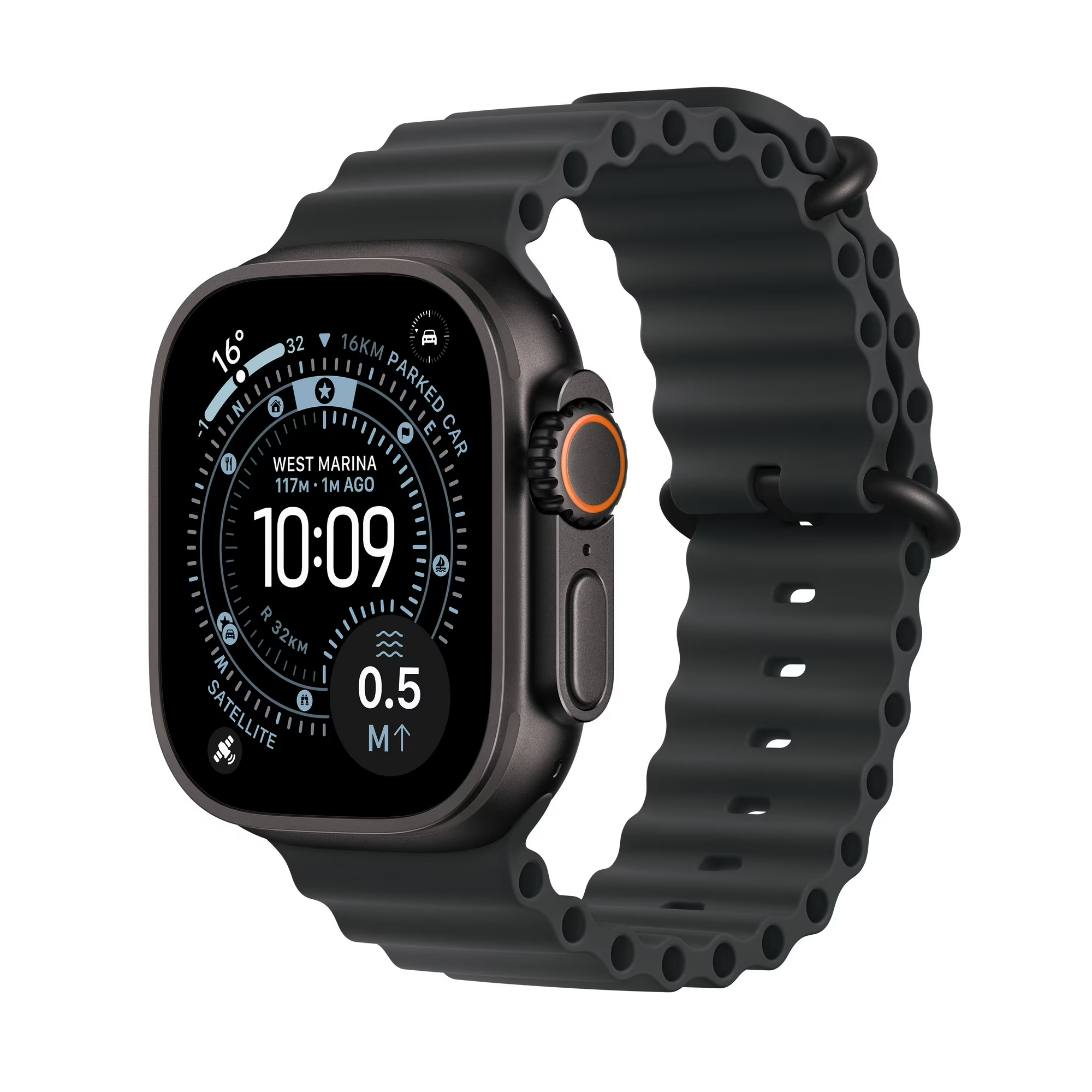
Apple Watch Ultra 3 · Pick this if…
Apple Watch for running

You are an iPhone user and you want a single device for daily life, fitness, and running. The Ultra 3 has dual-frequency GPS, a best-in-class optical HR sensor, and deep integration with Apple Fitness and Strava. It is a legitimate running watch for marathoners training for sub-4.

The catch: battery is still only 36 hours in low-power mode and around 12 hours with the display on running. For marathoners, fine. For anyone who hates daily charging or needs deep training-load analysis, Garmin wins.

Android users, skip this entirely. Ultra 3 needs an iPhone.

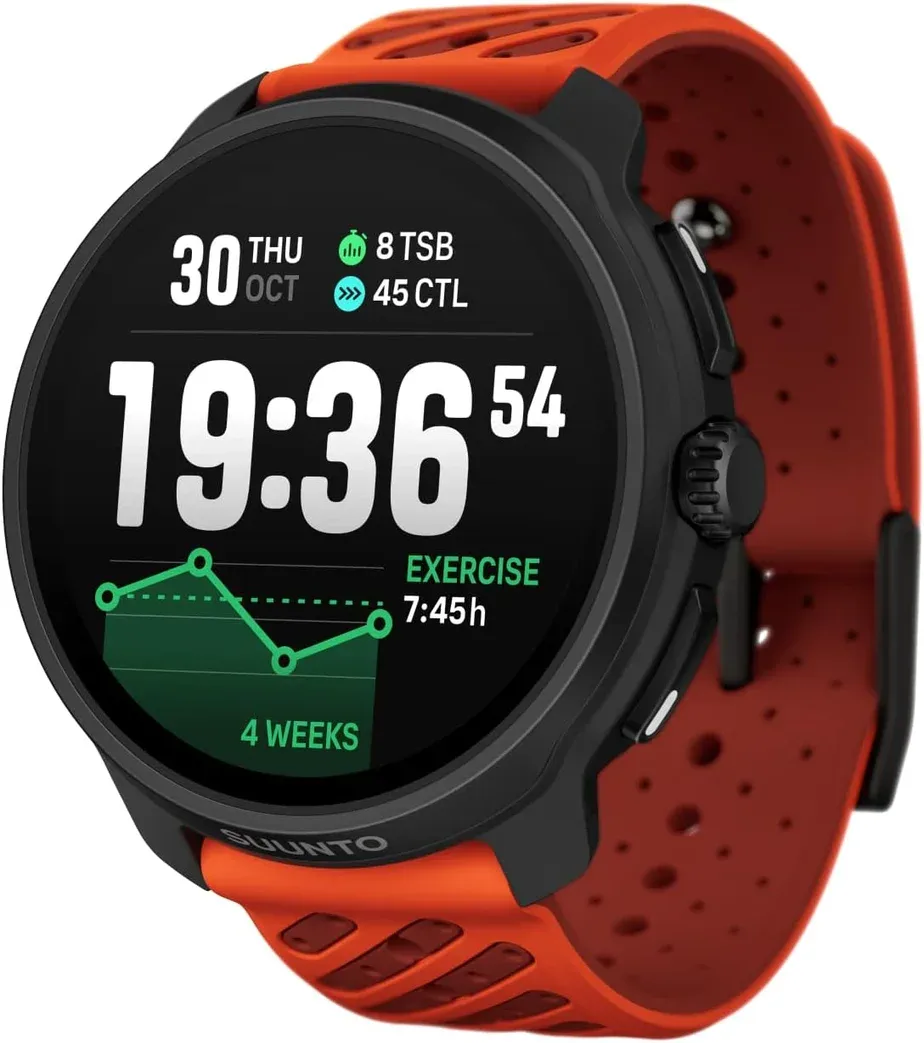
Polar, Suunto, and the rest · Should I care?

Polar still makes excellent heart rate sensors and their Polar Vantage line has solid training analytics, but the watch hardware has fallen behind. Suunto Race 2 is a genuinely good trail and ultra watch with great battery life, but weak for pure marathon training features. For most marathoners, the three-horse race in 2026 is Garmin, Coros, and Apple. Pick one of those.

Frequently Asked Questions

What is the best Garmin watch for marathon training in 2026?

For most marathon runners, the Garmin Forerunner 165 at around $249 is the best value in 2026. It has the AMOLED display, recovery metrics (Body Battery, Training Readiness), and battery life (19 hours GPS) that covers any marathon. If you are training for sub-3 or want the newest sensors, step up to the Forerunner 570 at $549 or the Forerunner 970 at $749.

Do I really need a $400+ watch to run a marathon?

No. A $200 watch like the Forerunner 55 or 165 will get you to the finish line. The difference between a $200 watch and a $700 watch is not whether you finish, it is the depth of training analysis, GPS accuracy in difficult environments, and the newest sensors. Most casual and first-time marathoners do not need more than the 165.

Is the Forerunner 265 still worth buying in 2026?

Yes, especially on sale. Garmin has replaced the 265 with the 570 as the current 5-series flagship, but the 265 is still sold and routinely discounted to $300 to $350. For a serious amateur marathoner who wants multi-band GPS, music, and Running Dynamics without paying $550, the discounted 265 is one of the best-value Garmin purchases you can make right now.

Forerunner 570 vs 970: which should I buy?

The Forerunner 970 ($749) adds full topographic maps, a sapphire crystal display, LED flashlight, ECG, Running Economy, and Running Tolerance over the 570 ($549). If you run trails, race in unfamiliar cities, or have a history of injury that makes Running Tolerance useful, the 970 is worth the extra $200. If you are a pure road marathoner with a familiar route stable, save the money and buy the 570.

What is Running Tolerance on the Forerunner 970?

Running Tolerance is a Garmin metric (currently exclusive to the Forerunner 970 and Fenix 8 Pro) that estimates the maximum weekly impact load your body can handle based on your training history. It helps prevent overuse injuries by capping how quickly you can ramp up volume. For marathoners with a history of shin splints, stress fractures, or plantar issues, it is one of the most genuinely useful running metrics Garmin has released.

Is single-band GPS good enough for a road marathon?

Yes, for most road marathons. Single-band GPS (found on the Forerunner 55 and 165) is typically accurate within 0.1 to 0.2 miles over a full marathon distance on suburban roads. Where it struggles is dense city canyons (tall buildings) and trails with heavy tree cover. If your goal race is Chicago, NYC, Boston, or London, the multi-band GPS on the Forerunner 265, 570, or 970 will give you more accurate splits. For a suburban marathon, single-band is fine.

Can I use an Apple Watch for marathon training instead of a Garmin?

Yes, the Apple Watch Ultra 3 has dual-frequency GPS and is a legitimate marathon watch. The tradeoffs are battery life (you will likely need to charge it mid-week) and less depth in the training-load and recovery analytics that Garmin Connect provides. If you are already an iPhone user and you want a single device for life plus sport, Apple works. For dedicated marathon training where you want the most training data, Garmin is still the better buy. Android users cannot use Apple Watch at all.

How accurate is wrist heart rate on a Garmin for training zones?

For easy runs, tempo runs, and long runs at a steady effort, modern Garmin wrist heart rate (especially the Elevate Gen5 sensor in the Forerunner 570 and 970) is accurate within a few beats per minute, which is plenty for zone training. For interval workouts with rapid intensity changes, wrist HR can lag or show spikes. If you do interval workouts regularly, pairing a chest strap (Garmin HRM-Pro Plus or Polar H10) with your watch is the right call.

Which Garmin watch has the longest battery life?

The Garmin Enduro 3 has the longest battery life of any Garmin watch, with around 60 hours of multi-band GPS and up to 36 days in smartwatch mode with solar assist. The Fenix 8 Pro 51mm is second. Among Forerunners, the 970 leads with 23 hours GPS and 15 days smartwatch. For pure marathon training, even the lowest-battery Forerunner covers any marathon distance comfortably.

Should I buy last year’s Garmin to save money?

Often yes. The Forerunner 265 is 95 percent as good as the newer 570 and routinely sells for $100+ less. The Forerunner 965 (discontinued but available) gives you most of the 970’s features for a significant discount. Garmin’s year-over-year improvements are real but incremental. If budget matters, last-gen Garmins are smart buys.

Still not sure which Garmin fits your training? Try the free Running Watch Finder quiz. Five questions, 60 seconds, and a matched recommendation from the 50+ watches we have tested.

Similar Posts