6 Best Running Headlamps for 2026: Road, Trail and Ultras
Once fall reaches Winnipeg, many of my weekday runs start before sunrise. I need enough light to see the pavement and trail edges, controls I can use with gloves, and a strap that stays put when I pick up the pace.
Quick answer
The Fenix HM65R-T V2.0 is my best overall running headlamp. I own it and use it for dark morning runs. It is brighter and tougher than most runners need, but its useful 400-lumen and 130-lumen settings, replaceable battery and secure dial-adjusted headband make it a dependable choice for roads, trails and overnight ultras.
Choose the Petzl NAO RL if you want reactive lighting and a rear red light. The new Nitecore UT6 has some of the strongest fixed-output runtime ratings here, but ours is being added to the test rotation, so I am not calling it personally tested yet.

As an Amazon Associate, we earn from qualifying purchases. If you buy through one of our links, we may earn a commission at no extra cost to you. Full disclosure.
Which running headlamp should you buy?
Start with the job. A one-hour road run, a technical trail and an overnight race do not need the same lamp.
Best overall
Fenix HM65R-T V2.0
The one I own. Strong runtime, glove-friendly controls and a weatherproof build.
Best everyday value
Petzl ACTIK CORE
Light, simple and able to use its CORE battery or three AAA batteries.
Best budget rechargeable
Black Diamond Spot 400-R
Compact, waterproof and enough for shorter road or trail runs.
Best backup
Nitecore NU25 MCT UL
Only 47 grams and easy to leave in a vest for an unplanned finish after dark.
What I have actually used
I own the Fenix and use it on dark morning runs. We are also adding the Nitecore UT6 to our gear, and I will update that section after it has been through fall and winter runs. The other picks are based on their official specifications and the needs they solve. I have not written them up as personal tests.
All runtime numbers below are manufacturer ratings. Cold weather, battery age, the brightness you choose and automatic step-downs can shorten real use, so never plan a remote run to the exact published limit.
Jump to: Comparison | Detailed picks | Buying guide | FAQs
Running headlamp comparison
The maximum number on the box is not the most useful number. The last column shows brighter settings you might realistically use while running.
| Headlamp | Best use | Max output | Weight | Useful rated runtime |
|---|---|---|---|---|
| Fenix HM65R-T V2.0 | Best overall | 1,600 lm | 140 g | 400 lm: 12 h 130 lm: 24 h |
| Nitecore UT6 | Overnight ultras | 1,600 lm | 130 g | 400 lm: 13 h 150 lm: 31 h |
| Petzl NAO RL | Reactive lighting | 1,500 lm | 145 g | Reactive standard: 5 to 40 h* |
| Petzl ACTIK CORE | Everyday runs | 625 lm | 88 g | 625 lm: 2 h 100 lm: 7 h |
| Black Diamond Spot 400-R | Budget rechargeable | 400 lm | 86 g | 400 lm: 4 h 200 lm: 8 h |
| Nitecore NU25 MCT UL | Backup light | 400 lm | 47 g | 200 lm: 5 h 60 lm: 13 h |
*Reactive runtime changes with the selected level, terrain and ambient light. Treat every figure as a planning estimate, not a guarantee.
The best headlamps for running
Best overall and the one I own
1. Fenix HM65R-T V2.0
A rugged running headlamp with a replaceable battery and useful all-night settings
- Max: 1,600 lumens
- Weight: 140 g
- Beam: 170 m
- Battery: Replaceable 18650
- Weather: IP68
Best for: runners who want one dependable light for early mornings, technical trails and overnight races.
This is the headlamp I reach for when my run starts in the dark. On regular morning routes, I do not need the full 1,600 lumens. The 400-lumen setting gives me a clear view ahead and is rated for 12 hours. On easier ground, 130 lumens stretches the rating to 24 hours.
The large numbers need context. Fenix’s 300-hour claim is for the 5-lumen Eco mode, which is useful around camp but not for running a dark technical trail. The high mode is better saved for checking a turn, scanning farther down a trail or handling a rough descent.
I also like the practical details. The rotary SPORT headband can be tightened without taking the lamp off, and the two top buttons are easier to find than one button that controls every function. You can switch between cool white and warm white light. The warm beam is useful when fog, snow or light rain throws glare back at you.
Why it works
- Owned and used on dark morning runs
- 400 lumens for a rated 12 hours
- Replaceable battery for long events
- Warm and cool white options
- IP68 dust and water protection
Watch for
- More noticeable on your head than a light training lamp
- No rear red light for road visibility
- Maximum output is for short use, not an entire run
- Costs more than a basic 400-lumen model
Buy it if: you run in darkness often and want one light that can move from weekday training to an overnight event.
Skip it if: most of your runs are short, well-lit and close to home.
Most promising new ultra option
2. Nitecore UT6
A new 100-mile-focused headlamp with long rated runtime and three colour temperatures
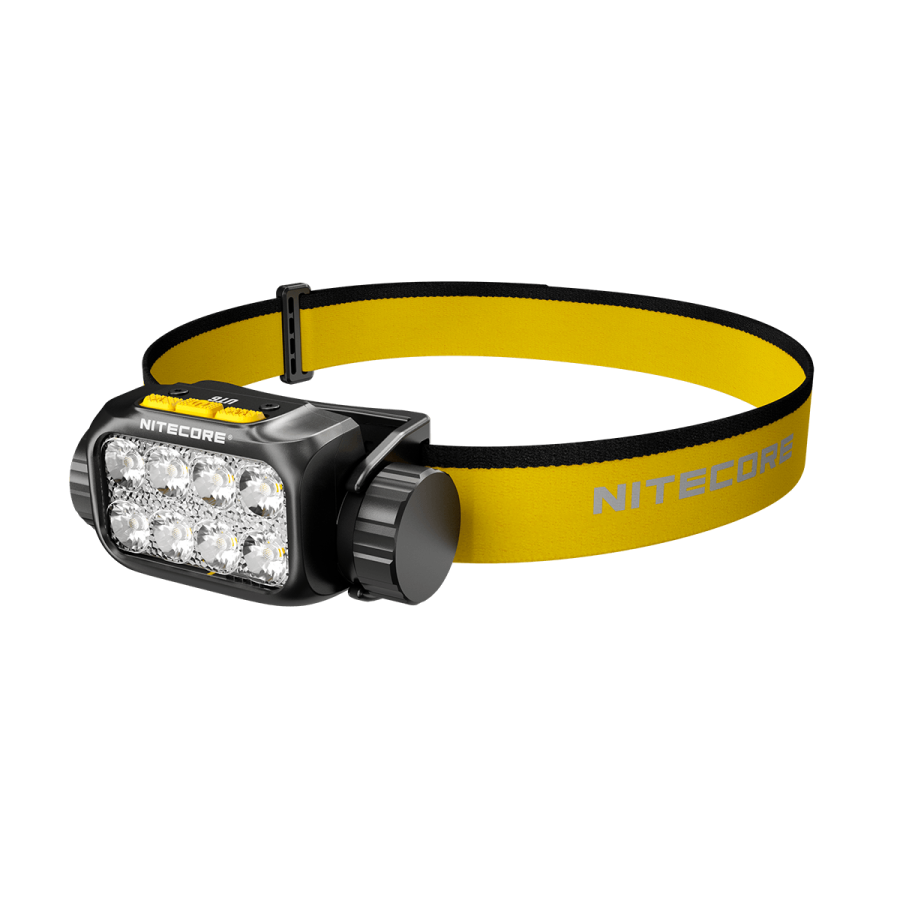
- Max: 1,600 lumens
- Weight: 130 g
- Beam: 195 m
- Battery: Replaceable 4,000 mAh 18650
- Weather: IP68
Testing status: We are adding the UT6 to our gear, but it has not yet completed Justin’s dark-run testing. This section uses Nitecore’s published specifications. We will add fit, bounce, cold-weather and real runtime notes after using it.
The UT6 is one of the most interesting new options for runners who spend a full night on the trail. Nitecore rates it for 13 hours at 400 lumens or 31 hours at 150 lumens. Those are much more useful numbers than a tiny Eco setting that lasts for days.
It also lets you choose warm 3000K, neutral 4500K or cool 6500K light without giving up the maximum 1,600-lumen output. Warm light can cut some glare in fog and rain. Neutral light is a good middle ground, while cool light looks brightest across open terrain.
The included battery can be removed and has its own USB-C charging port. That matters in a long race because you can carry a charged spare instead of waiting for the whole lamp to recharge. At 130 grams, it is also slightly lighter than the Fenix and Petzl NAO RL.
Why it stands out
- Rated for 13 hours at 400 lumens
- Three useful colour temperatures
- Replaceable battery with USB-C charging
- IP68 protection and 2-metre impact rating
- Designed specifically for long trail races
What still needs testing
- How secure the Rapid Reel headband feels while running
- How much output changes in cold weather
- Whether the controls are easy with gloves
- No rear red light for traffic visibility
Consider it if: long runtime at 150 to 400 lumens matters more than having reactive lighting.
Wait for our update if: you want personal fit and cold-weather feedback before buying a newly released lamp.
Fenix HM65R-T V2.0 vs Nitecore UT6
On paper, the UT6 is lighter, reaches farther and runs one hour longer at 400 lumens. It also adds a neutral light between warm and cool. The Fenix has the advantage that I already know how it feels and works on a run.
My decision right now
- Choose the Fenix if you want the model I own, a secure dial fit and a proven place in my morning kit.
- Choose the UT6 if the longer rated runtime and three colour temperatures solve a specific overnight-race need.
The UT6 may end up becoming my preferred ultra lamp. I will not call it the winner until I have run in it.
Best reactive lighting
3. Petzl NAO RL
A balanced premium lamp that adjusts its beam while you move

- Max: 1,500 lumens
- Weight: 145 g
- Beam: 200 m
- Battery: Replaceable Petzl R1
- Weather: IPX4
Best for: technical-trail and ultra runners who want the lamp to manage brightness for them.
The NAO RL’s sensor changes the brightness and beam shape as you look near or far. It can dim when you check a map, then throw more light when you look down the trail. That saves button presses and can stretch battery life.
The rear battery balances the 145-gram weight, and the red light at the back is useful when a route includes roads. Petzl lists a wide runtime range in reactive mode because the lamp’s output keeps changing. At the standard reactive level, the rated range is 5 to 40 hours.
This is the most expensive option here, and it uses Petzl’s own R1 battery instead of a common 18650 cell. It is also rated IPX4, which is enough for rain and splashes but not the same protection offered by the IP68 Fenix and UT6.
Why it works
- Reactive beam reduces manual changes
- Rear battery balances the weight
- Rear red light helps on road sections
- Wide and focused light in one beam
Watch for
- High price
- Proprietary battery costs more to replace
- IPX4 rather than full dust and water sealing
- The rear harness can take time to fit properly
Buy it if: you want reactive lighting, a balanced fit and a rear light for mixed road and trail routes.
Skip it if: you prefer simple manual controls or common, lower-cost batteries.
Best everyday value
4. Petzl ACTIK CORE
A light hybrid-power option for regular road and trail training

- Max: 625 lumens
- Weight: 88 g
- Beam: 115 m
- Battery: CORE or 3 AAA
- Weather: IPX4
Best for: runners who need a light for normal morning sessions and want a simple backup-power option.
The ACTIK CORE makes more sense for most weekday runs than a heavy ultra lamp. It weighs 88 grams, reaches 625 lumens and uses a simple one-button control. The mixed beam gives you some width near your feet while still lighting the route ahead.
Its biggest advantage is Petzl’s HYBRID CONCEPT. Use the included rechargeable CORE battery for daily training, then carry three AAA batteries as an emergency replacement. With the CORE battery, Petzl rates the standard 100-lumen mode for seven hours and maximum output for two hours.
The current official version is rated at 625 lumens, but some store listings still show an earlier 600-lumen description. Check the exact version before ordering. Either way, this is better suited to training or backup duty than leading you through an entire technical night.
Why it works
- Light enough for regular training
- Rechargeable CORE battery included
- Can switch to three AAA batteries
- Red mode and reflective headband
Watch for
- Not an all-night primary light at running brightness
- No rear red light
- IPX4 protection is weather resistant, not submersible
- Retailers may show 600 or 625-lumen versions
Buy it if: you want one light for weekday running, camping and occasional trail use.
Skip it if: you need a primary lamp for an entire night on technical terrain.
Best budget rechargeable
5. Black Diamond Spot 400-R
A compact waterproof headlamp for shorter dark runs

- Max: 400 lumens
- Weight: 86 g
- Beam: 100 m
- Battery: Integrated 1,500 mAh
- Weather: IP67
Best for: short road runs, easy trails and runners who want a lower-cost rechargeable lamp.
The Spot 400-R is small, straightforward and much tougher in wet weather than many entry-level lights. Its 400-lumen high mode is rated for four hours. The 200-lumen medium setting is rated for eight, which is the more useful number for a longer run on simple terrain.
Be careful with the product name. The Spot 400-R has an integrated rechargeable battery and cannot use AAA batteries. The regular Spot 400 is the dual-fuel version. The current article mixed those two models together, which could leave a buyer expecting a battery feature the 400-R does not have.
The 400-R also uses micro-USB rather than USB-C. That is not a problem at home, but it means one more cable to remember when much of your running gear has moved to USB-C.
Why it works
- Useful 200-lumen medium setting
- Compact 86-gram design
- IP67 waterproof rating
- Red mode and a digital lock
Watch for
- Integrated battery cannot be swapped
- Uses micro-USB
- No light at the back of the headband
- Not my choice for a remote all-night race
Buy it if: you want a compact rechargeable light for runs lasting a few hours.
Skip it if: you need replaceable batteries or expect to run through the full night.
Best ultralight backup
6. Nitecore NU25 MCT UL
A 47-gram light that is easy to keep in a vest for emergencies
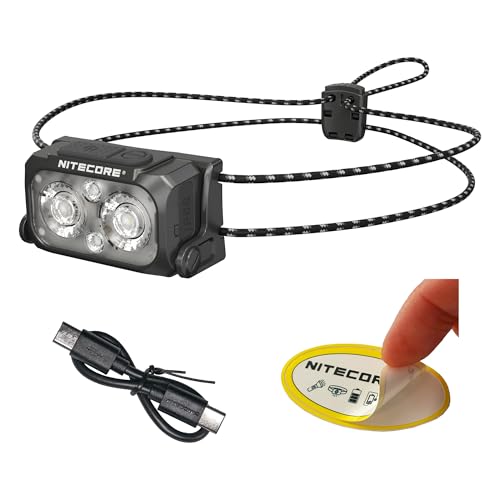
- Max: 400 lumens
- Weight: 47 g
- Beam: 132 m
- Battery: Integrated 700 mAh
- Weather: IP66
Best for: a required race backup, travel kit or runs that may finish a little later than planned.
A backup light only helps if you actually bring it. At 47 grams, the NU25 MCT UL is easy to leave in a small vest pocket. It still reaches 400 lumens and gives you warm, neutral and cool light settings.
The useful limits matter. Nitecore rates the 200-lumen mode for five hours and the 60-lumen mode for 13 hours. That is enough for an emergency walk-out or several hours on uncomplicated ground, but I would not choose it as my only light for a technical overnight ultra.
The battery is built in, so you cannot swap a fresh cell during a race. It charges through USB-C and has a lockout mode, which helps stop it from turning on inside your pack.
Why it works
- Only 47 grams with the UL headband
- Bright enough for a genuine backup
- Three colour temperatures
- USB-C charging and lockout mode
Watch for
- Not enough useful runtime for a full technical night
- Integrated battery cannot be replaced
- Cord-style headband will feel less structured
- No rear red light
Buy it if: you need a small backup you will not be tempted to leave at home.
Skip it if: this will be your only light for a long, technical night.
How to choose a running headlamp
Start with the terrain, not the biggest lumen number
A bright headline number is easy to compare, but beam shape and runtime matter just as much. A narrow beam may reach far while leaving the ground beside your feet dark. A wide beam gives better peripheral vision but may not show a trail marker far ahead.
A practical brightness starting point
- Lit roads and paths: 100 to 200 lumens may be enough to see the ground.
- Dark roads and simple trails: 200 to 400 lumens gives more room to react.
- Technical trails: 300 to 600 adjustable lumens is a useful working range.
- Route finding or fast descents: 800 lumens or more can help for short periods.
Your speed, eyesight, weather and comfort in the dark can move those numbers up or down.
Check runtime at the brightness you will use
The Fenix can run for 300 hours, but only at 5 lumens. The Spot 400-R reaches 225 hours at 6 lumens. Those settings can help around an aid station or campsite. They are not enough for running a rough trail at normal speed.
Look for the runtime beside a setting in the 150 to 400-lumen range. That is why the Fenix’s 12 hours at 400 lumens and the UT6’s 13 hours at 400 lumens are more meaningful for an overnight runner.
Build in a battery margin
Estimate how many hours you may actually spend in darkness, then add at least 25 percent. Add more if the forecast is cold, navigation could be slow or the battery is older. A 10-hour night should not be planned around a lamp rated for exactly 10 hours.
For an ultra, carry a second working light even when your main lamp accepts spare batteries. A dead lamp, damaged cable or broken strap can leave a fresh battery useless. Check your race’s required gear list too, since some events specify a backup light.
Choose a battery system you can support
- Replaceable 18650 battery: A good choice for long events because you can carry a charged spare. Use the exact type recommended by the manufacturer.
- Proprietary rechargeable pack: It may balance the lamp well, but replacements cost more and must match that model.
- Hybrid rechargeable and AAA: Convenient for travel and emergencies when you cannot recharge.
- Integrated battery: Simple for training, but the whole lamp must be charged and the cell cannot be swapped mid-run.
Fit is more than the weight on a scale
A 140-gram lamp can feel better than a lighter one if the strap spreads pressure and stops bounce. Rear batteries often feel balanced. Front-mounted batteries keep the design simple, but you may notice the weight more on rough ground.
Test the lamp with the hat or toque you will actually wear. Jog, look down, turn your head and try the buttons with gloves. If you must overtighten the strap to stop movement, that pressure will feel worse after several hours.
Warm light can help in poor weather
Cool white light can look crisp and bright on open ground. Warm light often creates less glare in fog, rain and falling snow. A neutral option sits between the two. Colour choice is not a substitute for enough output, but it can make a long dark run easier on your eyes.
A headlamp helps you see, but it may not help drivers see you
Most of the models here only shine forward. If you run beside traffic, add reflective material and a rear-facing red light. The Petzl NAO RL includes a rear red light, but I would still wear reflective gear and avoid assuming a driver has noticed me.
My five-minute check before a dark run
- Check the battery indicator and charge level.
- Turn on the setting you plan to use, not only the brightest mode.
- Confirm the lock, tilt and buttons work with gloves.
- Pack a second light for remote trails or races.
- Add a rear light or reflective layer when traffic is part of the route.
Dark-run safety: Tell someone where you are going, bring a charged phone and know the wildlife and route risks in your area. A powerful lamp improves visibility, but it does not remove the risk of running alone in darkness.
How these picks were updated
I started with the features that affect a run: usable brightness, runtime at that brightness, battery replacement, fit, weather protection and visibility from behind. Maximum lumens and maximum runtime were not scored on their own.
Specifications were checked in September 2026 against the official pages for the Fenix HM65R-T V2.0, Nitecore UT6, Petzl NAO RL, Petzl ACTIK CORE, Black Diamond Spot 400-R and Nitecore NU25 MCT UL.
Frequently asked questions
What is the best headlamp for running?
The Fenix HM65R-T V2.0 is my best overall choice because I own it, use it on dark morning runs and trust its useful 400-lumen and 130-lumen settings. The Petzl NAO RL is better if you specifically want reactive lighting and a rear red light.
Is the Nitecore UT6 better than the Fenix HM65R-T V2.0?
The UT6 looks stronger on paper because it is lighter, reaches farther and is rated for 13 hours at 400 lumens. The Fenix is still my current pick because I have used it, while our UT6 testing is still to come. I will update the comparison after running with both.
How many lumens do I need for running at night?
About 200 to 400 lumens is a useful range for dark roads and simple trails. Technical trails may feel better at 300 to 600 lumens, with a brighter setting available for route finding or rough descents. Beam shape, speed and weather also affect what feels bright enough.
Do I need a backup headlamp for an ultra?
Yes. Carry a second working light for an overnight or remote ultra, even if your main lamp has a replaceable battery. A broken strap, damaged lamp or missed charge can make a spare battery useless, and some races require a backup light.
How much headlamp battery life should I plan for?
Estimate your likely hours in darkness and add at least 25 percent. Add more for cold weather, an older battery or a route that could take longer than planned. Use the runtime at your intended brightness, not the maximum runtime printed on the box.
Does the Fenix headlamp really last 300 hours?
The Fenix HM65R-T V2.0 is rated for 300 hours only at its 5-lumen Eco setting. That is useful for close tasks but not for normal trail running. Its more relevant ratings are 12 hours at 400 lumens and 24 hours at 130 lumens.
Is a headlamp enough to make me visible to drivers?
No. A front-facing headlamp helps you see and may help approaching drivers notice you, but many models provide no light from behind. Add reflective clothing or a rear red light when you run near traffic.
Build the rest of your night-running kit
Planning a longer event? Start with our guide to ultra running, then compare running hydration packs, watches for ultra runners and trail running shoes. You can also browse the full running gear hub.