How to Actually Use a Running Training Plan
A running plan is not a test you pass by checking every box. It is a map. Each run has a job, and the real skill is keeping that job intact when work, weather, tired legs, or family plans get in the way.
The runners who use plans well are not always the ones who complete the most kilometres. They are the ones who train consistently, keep easy days easy, and know when one missed run is better than three crammed together.
How should you use a running training plan?
Start with a plan that matches what you can do now. Put the long run, harder workout, and recovery days into your real calendar. Then follow the purpose of each run instead of treating every pace and kilometre as a command.
If you miss a run, do not automatically make it up. Protect the rhythm of the week, adjust for fatigue and illness, and judge the plan by several weeks of training rather than one messy Tuesday.
Build a plan around your scheduleChoose a Plan for the Runner You Are Now
A plan can look perfect and still be wrong for you. Week one should feel like a manageable step from your recent training, not a sudden jump to the mileage you hope to handle two months from now.
Start with three honest questions:
- What have I actually run lately? Look at the last four to six weeks, not your best month from last year.
- How many days can I run most weeks? A four day plan only works if four days fit your life.
- Is my goal based on current fitness? A recent race or time trial is more useful than an old personal best.
If you are not sure where to begin, the Running Training Plans hub lets you compare the set 5K, 10K, half marathon, and marathon plans with the custom option.
Choose a set plan that matches your starting point
First 5K: If you can walk briskly for about 30 minutes and are ready to add short running intervals, start with the 8 week beginner 5K plan.
First 10K: If you can already cover about 4 to 5 km, even with walk breaks, the 8 week beginner 10K plan builds toward 10 km with three core runs and an optional recovery day.
First half marathon: If you can comfortably run about 3 miles or 5 km several times per week, use the 12 week beginner half marathon plan.
First marathon: The 20 week beginner marathon plan starts at 15 miles or 24 km in Week 1, so it is best if you already run roughly 10 to 15 miles or 16 to 24 km per week and can comfortably cover about 5 miles or 8 km.
If those dates, distances, or run days do not match your life, use the custom creator instead of forcing a set plan to fit.
The plan probably fits
- The first week is close to your recent routine.
- You can handle the listed run days without constant reshuffling.
- Easy runs feel controlled.
- The long run grows from a distance you already know.
Choose a different starting point
- Week one is already a major mileage jump.
- You need to skip recovery days to make the schedule fit.
- The first long run is much longer than anything recent.
- Your goal pace is based on fitness you no longer have.
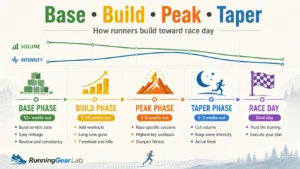
A good plan also changes as race day gets closer. The base, build, peak, and taper guide explains why the early weeks should not look like the final weeks.
Give Every Run a Job
Do not read a training plan as a list of distances. First ask what each run is trying to do. Once you know the purpose, it becomes much easier to adjust the pace, route, or day without ruining the week.
Build fitness without creating a big recovery cost
You should be able to speak in full sentences and finish with something left. If your easy days keep becoming steady efforts, read the 80/20 running guide before adding more speed.
Practise one specific kind of harder running
Intervals, hills, tempo runs, and race pace sessions should have a clear target. Warm up, do the planned work, and stop while your form is still controlled. More repeats are not automatically better.
Build endurance and practise race day habits
Most long runs should feel controlled. For half marathon and marathon training, they are also the place to test breakfast, fluids, fuel, shoes, and pacing. Do not turn every long run into a race simulation.
Let the previous work settle
Rest is not an empty square. It helps you arrive at the next important run ready to train. If you struggle to decide between an easy jog and a day off, use the recovery days guide to make the call.
Simple rule: Do not make support runs so hard that they spoil the runs with the biggest purpose.
Set Your Weekly Anchors Before You Move Anything
Most runners have one or two days that are harder to move. That might be a Sunday long run, a Tuesday track session, or a Friday rest day before a busy weekend. Put those anchors into your calendar first.
Then place easy running around them. A simple four day week could look like this:
If Wednesday is a strength day, the minimalist strength training guide for runners shows how to keep the session short enough that it supports the next run instead of competing with it.
How to move a run without breaking the week
- Keep space around the biggest efforts. Try to put an easy or rest day between a hard workout and the long run.
- Move easy runs first. They are usually more flexible than a key workout or long run.
- Do not create a three day pileup. A missed Tuesday run does not need to join Wednesday and Thursday.
- Keep the weekly purpose. If moving a run changes an easy day into another hard day, skip it.
Example: You miss Thursday intervals and still plan to run long on Sunday. Moving the workout to Friday can work if Saturday stays easy or becomes rest and your legs feel normal. If Friday is not available, skip the intervals. Do not squeeze them into Saturday before the long run.
Use the Right Measure for the Run
A training pace is a guide, not a promise. Heat, hills, wind, poor sleep, stress, and fatigue can all make the same pace cost more.
- Easy and recovery runs: Let breathing and effort lead. You should be able to talk comfortably.
- Tempo and race pace work: Use pace for structure, but reduce it if the effort is far harder than intended.
- Short intervals: Pace or effort usually responds faster than heart rate.
- Hills and trails: Hold the intended effort and let pace change with the terrain.
The heart rate zones versus pace zones guide shows which number is most useful for each type of run. If the watch and your body disagree, the purpose of the session should make the final decision.
What to Do When You Miss a Run
Missing a run is normal. The mistake is treating every missed kilometre like debt that must be repaid before Sunday.
You missed one easy run
Skip it and continue. One easy run will not decide your race.
You missed one workout
Move it only if you can preserve recovery before the next hard or long run. Otherwise, let it go.
You missed the long run
Move it if there is a safe place later in the week. Do not create a sudden distance jump or put it beside another hard session.
You missed two or three days
Return with an easy run. Do not make the first session back the hardest workout you missed.
You missed most of a week
Repeat the week if your race date allows it, or resume with a lighter version. Do not jump straight to the next peak week.
You missed two weeks or more
Rebuild from what you can do now and do not compress the missed training into fewer weeks. If race day no longer leaves enough time, change the goal, choose a later event, or get help adjusting the remaining plan.
A 2025 cohort study of more than 5,000 runners found a higher rate of overuse injury when a single run went more than 10 percent beyond the runner’s longest run in the previous 30 days. This was an observational study, so it does not prove a universal cutoff for every runner. It does give you a good reason not to replace a missed long run with one heroic jump.
Illness and pain need more caution. Do not use this missed run advice to push through fever, chest pain, unusual shortness of breath, dizziness, or pain that changes your stride. Return gradually after illness, and get medical advice when symptoms are moderate, severe, persistent, or concerning.
How to Tell if the Plan Is Working
Do not judge the plan by one fast run. Look for patterns across several weeks.
Keep going
Easy runs feel controlled, you recover between key sessions, the long run is manageable, and normal soreness settles.
Adjust the next few days
Easy pace feels hard for several runs, your legs never loosen up, sleep is poor, motivation suddenly drops, or workouts keep falling apart. Remove extra work and add recovery before the pattern grows.
Stop and deal with the problem
Sharp pain, a changed stride, chest pain, faintness, unusual breathing trouble, or worsening illness is not a normal training plan problem. Stop running and get appropriate medical help.
Keep a simple training log
After each run, record the distance or time, the type of run, an effort score from 1 to 10, and one short note about how you felt. That is often enough to spot a pattern.
A GPS watch can make distance, lap pace, and heart rate easier to track, but it should not make the plan more complicated. The best running watches guide focuses on useful training features at different prices rather than assuming every runner needs a premium model.
Do Not Try to Win the Taper
When the plan cuts mileage before race day, let it. The goal is to lower fatigue, not prove that you are still fit.
Do not add the long run you missed three weeks ago. Do not test a new workout. Keep the short efforts the plan calls for, reduce the overall load, and arrive wanting to run more.
A 2023 review of endurance tapering found that reducing training volume while maintaining some intensity and frequency can improve performance. The exact taper depends on your race and training history, so follow the shape of your plan instead of copying one percentage from a study.
Your five minute Sunday plan check
- Put the long run and workout into your real calendar.
- Protect at least one recovery day after a demanding run.
- Check weather, work, travel, and family conflicts.
- Decide which easy run you would drop if the week gets crowded.
- Look back at fatigue, pain, sleep, and effort from the last week.
- Keep the plan easier if your body is not absorbing the work.
Running Training Plan FAQ
Should I make up a missed run?
Usually not. Skip a missed easy run. Move a workout or long run only if you can keep enough recovery around it. Do not cram several missed sessions into the remaining days.
Can I move my long run to a different day?
Yes. Keep an easy or rest day before or after it when possible, especially during half marathon and marathon training. Move the surrounding easy run rather than stacking the long run beside a hard workout.
Which run is most important each week?
It depends on the goal and the phase. A long run matters more in half marathon and marathon training. A focused workout may carry more weight in a 5K build. Consistency still matters more than saving one session at any cost.
How do I know if my plan is too hard?
Week one should be close to your recent training. If easy runs feel hard for several days, workouts repeatedly fall apart, fatigue keeps growing, or the schedule only works when you skip rest, step back or choose a plan with less volume.
Should I follow pace or heart rate?
Use effort or heart rate to control most easy runs. Pace is often more useful for tempo work, intervals, and race pace practice on steady terrain. Heat, hills, wind, and fatigue should still change how strictly you follow either number.
Make the Plan Fit Before You Make It Harder
If you already have a sensible schedule, use the weekly check above and keep going. If the plan never fits your run days, current fitness, or race date, use the Running Training Plan Creator to rebuild it around the week you can actually complete.
Sources checked: Guidance on illness and returning to training was checked against the IOC consensus on acute respiratory illness in athletes. The advice about sudden long run jumps reflects a 2025 cohort study of 5,205 runners. Taper guidance was checked against a 2023 systematic review and meta analysis.