Heart Rate Zones vs Pace Zones for Running

Heart rate zones and pace zones can both help your running, but they are not the same tool.

Heart rate tells you how your body is responding. Pace tells you how fast you are moving. Some days those two numbers line up nicely. Other days they argue with each other because of heat, hills, wind, poor sleep, stress, caffeine, or a watch that is not reading quite right.

The goal is not to pick one number and ignore the rest. The goal is to know which number matters most for the run you are doing today.

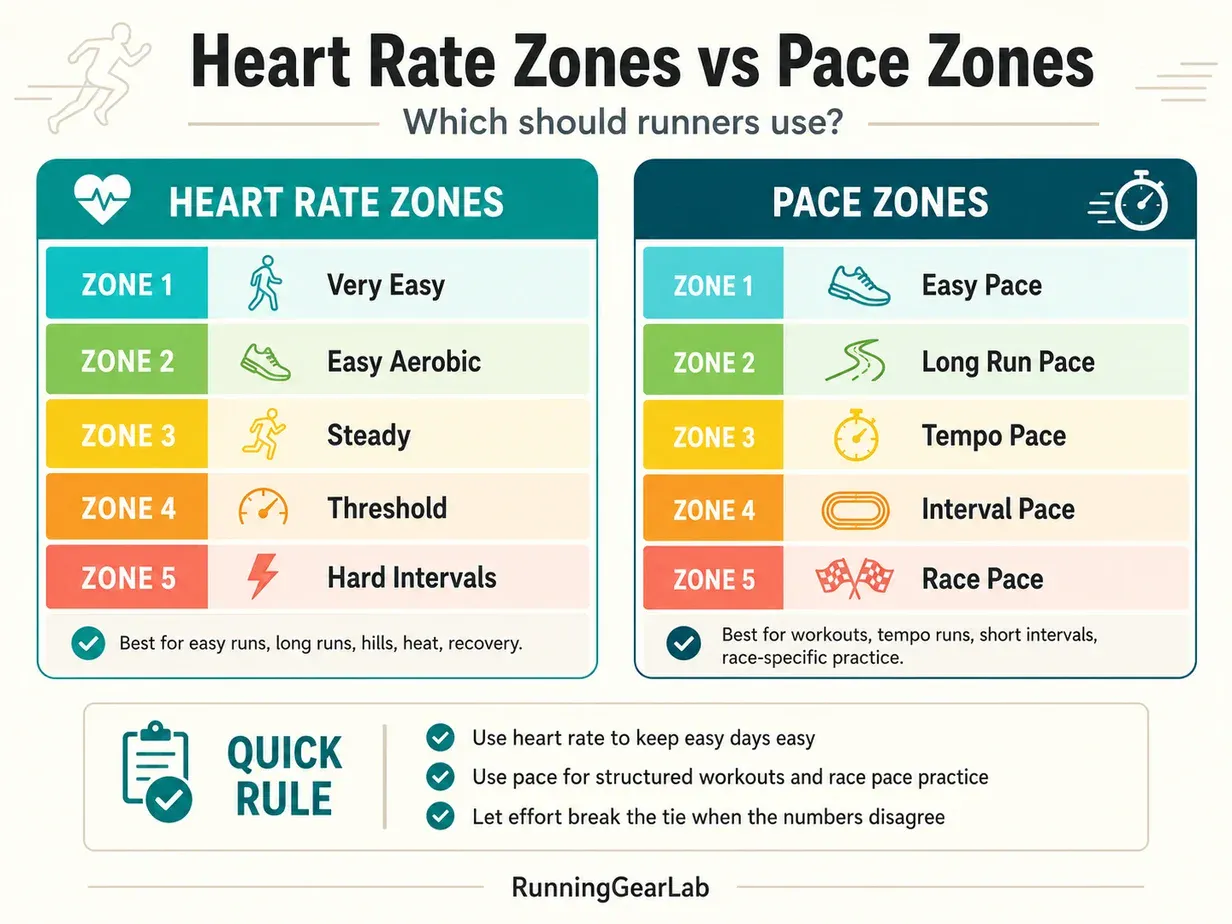
Infographic comparing heart rate zones and pace zones for runners
Heart rate zones can help control easy effort. Pace zones are often better for structured workouts and race-specific practice.
What This Guide Covers
  • Heart rate zones: When they help and when they can mislead you
  • Pace zones: When pace is useful and when it becomes too rigid
  • Easy runs: Why heart rate and effort often work better than strict pace
  • Workouts: Why pace is often better for short intervals and race-specific sessions
  • Real-life conditions: How heat, hills, wind, and fatigue change the answer
  • Simple decision rule: Which cue to use for each type of run

Quick Answer

Should Runners Use Heart Rate Zones or Pace Zones?

Use heart rate zones for easy runs, long runs, recovery runs, and hot or hilly days when pace can trick you into running too hard. Heart rate helps you keep the effort under control.

Use pace zones for flat workouts, race-pace practice, tempo runs, and short intervals where heart rate lags behind the effort. For most runners, the best approach is heart rate plus pace plus perceived effort, not one number alone.

Start Here

What Are Training Zones?

Training zones are ranges that help you control effort. Instead of running every day at the same speed, zones give different runs different jobs.

An easy run should feel calm and repeatable. A tempo run should feel controlled but uncomfortable. A short interval should feel hard, but it should also have enough recovery built in.

Simple way to think about it: Zones are not magic lines. They are guide rails. A few beats or a few seconds outside a zone does not ruin the run. The bigger question is whether the run matched its purpose.
Zone StyleWhat It MeasuresBest For
Heart rate zonesHow hard your body is working based on beats per minuteEasy runs, long runs, recovery days, hot days, hilly routes
Pace zonesHow fast you are moving, usually min/km or min/mileRace pace, tempo runs, flat workouts, short intervals
Perceived effortHow the run feels based on breathing, control, and fatigueEvery run, especially when the watch numbers disagree
Body Response

Heart Rate Zones for Running

Heart rate zones use your pulse to guide training intensity. Most basic calculators use five zones, often based on a percentage of maximum heart rate or heart rate reserve.

Heart rate is useful because it shows internal load. If it is hot, humid, hilly, windy, or you are tired, your heart rate may be higher at a slower pace. That is not failure. It is your body telling you the run costs more today.

Common 5-Zone Heart Rate Setup

  • Zone 1: Very easy recovery
  • Zone 2: Easy aerobic running
  • Zone 3: Moderate or steady running
  • Zone 4: Hard threshold-style effort
  • Zone 5: Very hard interval effort

Heart Rate Works Well For

  • Easy runs
  • Long runs
  • Recovery runs
  • Heat and humidity
  • Hilly routes
  • Keeping yourself honest on easy days

Heart Rate Struggles With

  • Short intervals
  • Fast pace changes
  • Wrist sensor errors
  • Bad max heart rate estimates
  • Caffeine, stress, and poor sleep
  • Trying to chase a number every second
Coach note: Heart rate is great for slowing runners down. It is less great when a runner stares at the watch every ten seconds and forgets to listen to breathing, legs, and effort.
External Output

Pace Zones for Running

Pace zones use speed to guide the run. Most runners see pace as minutes per kilometre or minutes per mile.

Pace is simple and race-specific. If your goal is to run a 25-minute 5K or a 2-hour half marathon, pace helps you practise what that speed feels like.

The problem is that pace does not know how hard the day is. A 6:00/km pace on a cool flat path can feel very different from 6:00/km into wind, up rolling hills, or during a humid afternoon.

Pace Works Well For

  • Flat workouts
  • Tempo runs
  • Race pace practice
  • Short intervals
  • Track sessions
  • Learning goal-race rhythm

Pace Struggles With

  • Heat
  • Hills
  • Trail routes
  • Wind
  • GPS glitches downtown or under trees
  • Easy days when you are tired
Practical rule: Pace is best when conditions are steady. Heart rate and effort are usually better when conditions are messy.
Decision Guide

Heart Rate vs Pace Zones: Which Should You Use?

Most runners should use both, but not equally on every run.

For easy days, heart rate and effort should usually win. For workouts on flat ground, pace can be more useful. For races, pace gives structure, but effort and heart rate can stop you from doing something silly early.

SituationBest Main CueWhy
Easy runHeart rate or effortKeeps the run easy enough to recover from
Long runHeart rate, effort, then paceHelps manage fatigue and heat drift
Short intervalsPace or effortHeart rate often rises too slowly to guide short repeats
Tempo runPace plus effortPace helps structure the workout, effort keeps it controlled
Hilly routeEffort or heart rateTrying to hold pace uphill can make the run too hard
Hot dayHeart rate or effortYour normal pace may cost more than usual
Race pace practicePace plus effortYou need to learn the rhythm of your goal pace
Trail runEffortTerrain can make pace nearly useless
Best answer for most runners: Use heart rate to keep easy days easy, pace to practise race-specific speed, and effort as the final check when the numbers disagree.
Run Type

Which Zone Method to Use by Run Type

The right answer changes with the workout. Pick the type of run below for a simple guide.

Pick Your Run

Best cue: heart rate or effort

Easy runs

Use heart rate as a cap, not a target to chase. If your heart rate climbs too high for the day’s easy zone, slow down, shorten the run, or use run-walk. You should be able to talk in full sentences.

Best cue: effort first, heart rate second

Long runs

Use heart rate and breathing to stop the long run from becoming a hidden workout. Pace can be helpful, but long runs often change with hills, heat, and fatigue. Keep the first half controlled.

Best cue: pace plus effort

Tempo runs

Pace can help you avoid starting too fast or too slow. Effort should still feel controlled. If the same pace feels much harder than usual, adjust instead of forcing the number.

Best cue: pace or effort

Short intervals

Heart rate often lags during short repeats, so pace or effort is usually better. Use heart rate during recoveries if you like, but do not sprint harder just because the heart rate number has not caught up yet.

Best cue: pace with effort checks

Race day

Pace gives you structure. Effort keeps you honest. Heart rate can be useful, but race nerves, heat, caffeine, and hills can change the reading. Do not let one number override common sense.

Set It Up

How to Set Heart Rate Zones and Pace Zones

Your zones are only as useful as the numbers behind them. A rough estimate can be fine when you are starting out, but do not treat it like a lab result.

How to Set Heart Rate Zones

Heart rate zones are often based on maximum heart rate, heart rate reserve, or lactate threshold heart rate. The simple max-heart-rate method is easy, but it can be off for individual runners.

MethodHow It WorksBest For
Age estimateUses an equation such as 220 minus age or Tanaka-style estimatesQuick starting point only
Heart rate reserveUses max heart rate and resting heart rateRunners who know reliable resting heart rate
Threshold heart rateUses a hard field test or lab result to set zones around thresholdRunners who train seriously with heart rate
Lab testUses supervised testing to measure physiological markersRunners who want the most precise setup

Heart Rate Reserve Formula

  • Heart rate reserve: max heart rate minus resting heart rate
  • Target heart rate: resting heart rate plus heart rate reserve multiplied by the target intensity
  • Why it helps: It accounts for resting heart rate instead of using max heart rate alone

How to Set Pace Zones

Pace zones are usually based on a recent race, time trial, threshold pace, or a running calculator. A recent 5K, 10K, half marathon, or marathon result can help estimate training paces.

The better your input, the better your pace zones. A race from two years ago may not match your current fitness. A time trial done on a windy, icy, or hilly route may not translate perfectly either.

Use zones as a starting point: If your easy pace zone says one thing but your breathing says another, listen to your breathing. If a workout pace feels wildly wrong, adjust and review the plan.
Watch Reality

Watch Accuracy: Why the Numbers Can Be Wrong

Watches are useful, but they are not perfect.

Wrist heart rate can lag during hard efforts, read oddly in cold weather, or struggle if the watch is loose. GPS pace can jump around under trees, around tall buildings, on tight turns, or on trails.

Better Habits

  • Use lap pace instead of instant pace for workouts
  • Tighten the watch slightly for better wrist heart rate
  • Use a chest strap if heart rate accuracy really matters
  • Check effort before reacting to one weird number
  • Review trends after the run instead of obsessing mid-run

Avoid This

  • Sprinting to force heart rate higher
  • Slamming the brakes because instant pace jumps
  • Assuming every watch reading is correct
  • Ignoring heat, hills, and stress
  • Letting the watch make easy runs stressful
Coach note: I like watches, but the watch is not the coach. If the number looks strange and your body feels normal, give it a minute before changing the whole run.
Common Errors

Common Heart Rate and Pace Zone Mistakes

1

Using pace zones for every easy run

Easy pace changes with weather, hills, and fatigue. If you force the same easy pace every day, it may not stay easy.

2

Using heart rate for short intervals

Heart rate usually takes time to catch up. For short repeats, pace and effort often guide the work better.

3

Trusting bad zone settings

If your max heart rate estimate is wrong, your zones may be wrong. Use effort and breathing to check whether the numbers make sense.

4

Ignoring cardiac drift

On long runs, heart rate can rise even when pace stays the same. Heat, dehydration, fatigue, and fuel can all play a role.

5

Forgetting perceived effort

Your breathing, leg feel, and ability to talk are useful data too. Do not ignore them just because the watch has numbers.

Back off when needed: Chest pain, dizziness, faintness, unusual shortness of breath, or symptoms that feel wrong are not training-zone problems. Stop and get medical help if needed.
Training Plan Fit

How to Use Zones With a Training Plan

A good training plan should tell you the purpose of the run. Zones are there to help you match that purpose.

If the plan says easy, your job is to keep the effort easy. Heart rate and the talk test are useful here. If the plan says tempo, pace can help you hold a steady rhythm. If the plan says intervals, pace or effort is often more useful than heart rate.

Simple rule for training plans: Easy days are controlled by effort. Workout days are guided by the workout goal. Race-specific days use pace, but effort still gets a vote.

If you need a plan that fits your current level, start with the Running Training Plan Creator. If your easy runs keep turning too hard, read the 80/20 running rule guide next.

Build your next training block

Use the Running Training Plan Creator

Pick your race distance, current running level, and weekly schedule. Then use heart rate, pace, and effort to keep each run matched to its purpose.

Open the Training Plan Creator

The right zone depends on the run you are doing today.

Gear and Tools

Helpful Gear and Tools for Zone Training

You do not need expensive gear to use zones, but some tools can make them easier to follow.

A running watch can help with pace, lap splits, heart rate, and alerts. If you are choosing one, use the Running Watch Finder. If you are training for a longer race, you can also compare our marathon running watch guide.

A chest strap can be useful if heart rate accuracy matters to you, especially for workouts where wrist readings jump around. It is not required for every runner, but it can reduce guessing.

Shoes and socks still matter because discomfort changes effort. If your easy runs feel rough because your shoes are not working, start with the Running Shoe Finder. You can also compare the best running shoes, best cushioned running shoes, and best running socks.

Weather changes both heart rate and pace. Before hot or cold runs, the Running Temperature Outfit Calculator can help you dress more comfortably.

Common Questions

FAQ

Are heart rate zones or pace zones better for beginners?
Heart rate and effort are often better for beginners on easy runs because they help stop easy days from becoming too hard. Pace can still be useful, but beginners should not chase pace on every run.
Should I use heart rate or pace for easy runs?
Use heart rate or perceived effort for most easy runs. You should be able to speak in full sentences and finish feeling like you could have kept going. If pace makes you run too hard, ignore pace for that run.
Should I use heart rate or pace for intervals?
Use pace or effort for short intervals because heart rate often rises too slowly to guide the repeat. Heart rate can still be useful during recovery, but it should not be the main target for short fast work.
Why is my heart rate high even when my pace is slow?
Heat, humidity, hills, dehydration, stress, poor sleep, caffeine, fatigue, and illness can all raise heart rate. Wrist sensors can also misread. Slow down, check effort, and do not force the pace if the run is supposed to be easy.
Are wrist heart rate monitors accurate enough for running?
Wrist heart rate can be useful for easy runs and trends, but it can lag or misread during fast changes, cold weather, or if the watch is loose. A chest strap is usually better if heart rate accuracy really matters.
How do I calculate heart rate zones?
Common methods use maximum heart rate, heart rate reserve, or threshold heart rate. Age-based formulas are only estimates. Heart rate reserve uses both maximum and resting heart rate, which can make zones feel more personal for some runners.
How do I calculate pace zones?
Pace zones are usually based on a recent race, time trial, threshold pace, or running calculator. The more current and realistic your input is, the more useful your pace zones will be.
What should I do if heart rate and pace disagree?
Look at the purpose of the run. If it is an easy run, trust effort and heart rate more than pace. If it is a flat workout, pace may matter more. If your body feels unusually bad, back off instead of forcing either number.

Bottom Line

Use the Right Cue for the Right Run

Heart rate zones are best for controlling easy effort, long runs, heat, hills, and recovery days. Pace zones are best for workouts, race-pace practice, and short intervals on steady terrain.

The best runners are not ruled by one number. They use pace, heart rate, breathing, and common sense together.

Sources checked: RunBryanRun heart rate vs pace training guide, Marathon Handbook heart rate training zones, RunCalcs heart rate zone calculator, CDC measuring physical activity intensity, Mayo Clinic exercise intensity guidance, 80/20 Endurance zone calculator.

Similar Posts

Leave a Reply

Your email address will not be published. Required fields are marked *