80/20 Running Rule: Why Most Runs Should Feel Easy
Most runners understand hard work. The harder lesson is learning when to back off.
The 80/20 running rule is a simple way to think about training balance. About 80 percent of your running should feel easy, controlled, and repeatable. About 20 percent can be harder, such as intervals, tempo runs, hills, or race pace work.
That sounds simple, but it is one of the most common things runners get wrong. A lot of easy runs quietly turn into medium-hard runs. They are not fast enough to build speed well, but they are too hard to recover from. I have done this too. You finish the run feeling proud because the pace looked good, then two days later the workout you actually needed to hit feels flat.
- The simple 80/20 idea: Why most runs should feel easy and a smaller amount should feel harder
- Easy effort: How to know if your easy pace is actually easy
- Hard effort: What should count as the harder 20 percent
- Training plans: How to use 80/20 training for 5K, 10K, half marathon, and marathon plans
- Common mistakes: Why runners get stuck in the middle without noticing
- Plan and recovery fit: How easy effort, harder workouts, rest days, and training phases work together
Quick Answer
What Is the 80/20 Running Rule?
The 80/20 running rule means roughly 80 percent of your training should feel easy and about 20 percent can be moderate to hard. Easy means you can speak in full sentences, your breathing stays controlled, and you finish feeling like you could have kept going.
The hard 20 percent includes planned workouts like intervals, tempo runs, hill repeats, fartlek, race pace work, and races. New runners do not need to count every minute perfectly. The first goal is learning how easy an easy run should feel.
Jump to:
What Is 80/20? Why Easy Runs Help How Easy Should Easy Feel? The Hard 20 Percent Sample Week Different Runners Common Mistakes Use It With a Plan FAQ Last Updated: June 2026What Is the 80/20 Running Rule?
The 80/20 rule is a training balance idea. In simple terms, most of your running is easy and a smaller part is harder. It is often linked with polarized training, where runners spend a lot of time at low intensity, some time at high intensity, and less time stuck in the middle.
The key word is roughly. This does not mean every week needs to be measured with a calculator. It also does not mean every runner needs the same exact split. For most everyday runners, 80/20 works best as a check on your habits.
A common mistake is counting a whole workout day as hard. For example, a 50 minute workout might include 15 minutes of harder running, plus an easy warmup, recovery jogging, and cooldown. In that case, the hard part is closer to 15 minutes, not the full 50.
Why It WorksWhy Most Runs Should Feel Easy
Easy running is not wasted running. It is where a lot of your aerobic fitness is built. It helps your body practise running without asking for a hard recovery every time.
That matters because training is not just about one strong run. It is about stacking enough good weeks together that your body has time to adapt. Easy runs help you build that routine.
Easy runs build your aerobic base
Low effort running helps you spend more time on your feet without needing every run to feel like a test. This is useful for 5K runners, marathon runners, and anyone trying to become more consistent.
Easy days help hard days work better
If Tuesday is supposed to be a workout, Monday should not secretly become a race. Keeping easy runs easy gives your legs a better chance of showing up for the harder sessions.
Easy running helps you add volume carefully
Many runners get hurt or burned out when they add distance and intensity at the same time. Easy running can make mileage increases more manageable, as long as you still build gradually.
How Easy Should Easy Runs Feel?
Easy should feel controlled. You should not be chasing pace, fighting your breathing, or finishing cooked. On most easy runs, you should feel like you could keep going for a bit longer if you had to.
Easy Run Signs
- You can speak in full sentences
- Your breathing is steady
- You are not checking pace every few seconds
- You finish feeling calm, not drained
- You could do the same run again later in the week
Too Hard Signs
- You can only speak in short phrases
- Your breathing feels rushed
- You are trying to beat last week’s easy pace
- Your legs feel heavy the next day
- Your planned workout feels flat after it
The talk test is often the easiest way to judge effort. If you can hold a relaxed conversation, you are probably close. If you can only get out a few words at a time, the run is not easy anymore.
Can You Use Heart Rate?
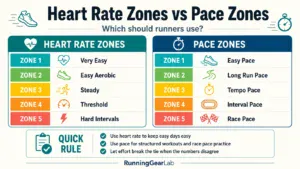
Yes, but do not let your watch boss you around. Heart rate can be useful for spotting patterns, but wrist heart rate is not perfect. It can lag during changes in pace and may read oddly if the watch is loose, cold, or not sitting well on your wrist.
For most runners, effort should come first. Use heart rate as a second check, not the whole answer. If your watch says easy but your breathing says hard, listen to your breathing.
The Faster WorkWhat Counts as the Hard 20 Percent?
The hard 20 percent should be planned. It is not every run that got away from you. It is the part of training where you ask your body for a stronger effort on purpose.
| Workout Type | How It Feels | Simple Example |
|---|---|---|
| Tempo run | Controlled but uncomfortable | 15 to 60 minutes at a steady effort after an easy warmup |
| Intervals | Hard, with recovery between repeats | 5 x 5 minutes hard with easy jogging between |
| Hill repeats | Strong effort uphill | 8 short uphill repeats with walk or jog recovery |
| Fartlek | Playful pace changes | 1 minute quicker, 2 minutes easy, repeated several times |
| Race pace work | Specific to your goal race | Short blocks at 10K, half marathon, or marathon effort |
| Races | Harder than normal training | 5K, 10K, half marathon, marathon, or tune-up race |
Sample 80/20 Training Week
Here is a simple example for a recreational runner who runs four days per week. The exact distances can change based on your current fitness and race goal.
| Day | Run | Effort | 80/20 Notes |
|---|---|---|---|
| Monday | Rest, walk, or strength | Easy | No hard running |
| Tuesday | Easy run | Easy | Conversational pace |
| Wednesday | Rest or light cross-training | Easy | Keep it light |
| Thursday | Workout with warmup, repeats, cooldown | Mixed | Only the repeats count as hard |
| Friday | Rest | Easy | Let the workout settle |
| Saturday | Easy run | Easy | Do not race it |
| Sunday | Long easy run | Easy | Keep it controlled |
This kind of week works because the hard work has a place. The easy runs are not filler. They support the workout and the long run.
By GoalHow 80/20 Works for Different Runners
The idea is the same, but the way you use it changes based on your experience and race distance.
Pick Your Running Goal
Beginner runners
Do not worry about hitting a perfect 80/20 split. Your first job is to make running feel repeatable. Most runs should feel easy, and run-walk breaks are fine. If every run feels like survival, slow down, shorten the run, or walk before you need to.
5K runners
The 5K is short enough that speed matters, but that does not mean every run should be fast. Keep most runs easy and use one planned workout each week for quicker running. This helps you practise speed without turning every day into a pace test.
10K runners
A 10K rewards both endurance and controlled speed. Easy runs help you build the base, while one workout can focus on tempo, intervals, or hills. Avoid making your long run too hard unless the plan clearly calls for it.
Half marathon runners
Half marathon training often goes wrong when every run becomes medium hard. Keep easy runs easy so your long run and tempo work have a purpose. The hard work should be planned, not accidental.
Marathon runners
Marathon training already asks a lot from your body. If you run easy days too fast, the weekly volume can catch up with you. Keep most mileage comfortable and save harder running for clear workout days or race pace blocks inside the plan.
Common 80/20 Running Mistakes
Running easy days too fast
This is the big one. If your easy pace looks good online but leaves you tired for the next workout, it is not helping as much as you think.
Turning every run into a test
You do not need to prove your fitness every day. Some runs should feel almost boring. That is part of the point.
Counting the whole workout as hard
Warmups, cooldowns, and easy recovery jogging still count as easy time. Count the harder portions separately if you are tracking the split.
Ignoring heat, hills, and fatigue
Your easy pace on a cool flat path will not be the same as your easy pace in heat or on rolling hills. Use effort first.
Adding speed before consistency
If you are only running once or twice a week, your best next step is usually a steadier routine, not more hard workouts.
How to Use the 80/20 Rule With a Training Plan
A good training plan should tell you which days are easy, which days are harder, and when to rest. Your job is not to make the plan harder every time you feel good. Your job is to follow the purpose of each day.
If you are choosing a full plan, start with a plan that matches your current running, not the runner you wish you were next month. If you already have a plan but keep moving runs around, fix the weekly structure before adding more workouts.
Do This
- Keep easy days conversational
- Use one clear hard workout at a time
- Build mileage gradually
- Take rest days seriously
- Adjust for heat, hills, and poor sleep
Avoid This
- Adding extra intervals because you feel good
- Racing your easy runs
- Skipping warmups and cooldowns
- Using pace as the only guide
- Trying to force a perfect 80/20 split every week
Keep easy days honest
Use the Heart Rate Zone Calculator
Estimate your easy, moderate, and harder running zones so you have a second check when pace starts to pull you too fast.
Open the Heart Rate Zone CalculatorUse zones as a guide, then adjust for heat, hills, fatigue, and how the run feels.
FAQ
Is the 80/20 rule good for beginners?
Should I count 80/20 by time or distance?
How slow should my easy runs be?
Can I use run-walk with 80/20 training?
What if my heart rate is high on easy runs?
Is Zone 2 the same as easy running?
Can I still do speed work with 80/20 running?
What if I only run 3 days per week?
Bottom Line
Most Runners Do Not Need Harder Training First
Most runners need better-balanced training. Keep most runs easy enough that you can recover, save harder work for planned days, and build a routine you can repeat.
The 80/20 rule is not magic and it is not a strict law. It is a practical reminder: easy days should actually feel easy, and hard days should have a clear reason.
Sources checked: 80/20 Endurance, Stöggl and Sperlich polarized training research, CDC talk test guidance, Mayo Clinic exercise intensity guidance.