Heart Rate Zones vs Pace Zones for Running
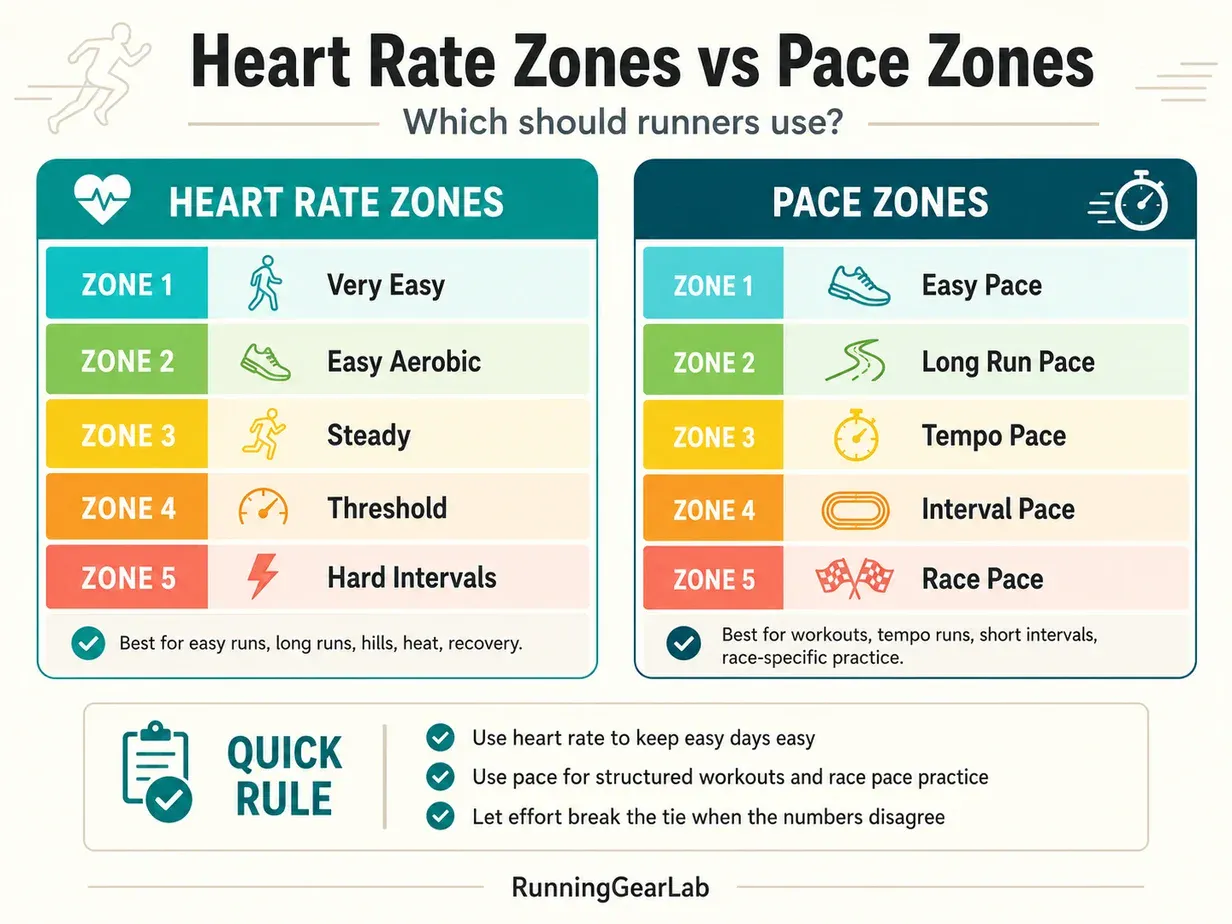
Heart rate tells you how your body is responding. Pace tells you how fast you are moving. Neither number is enough on its own, and the best cue changes with the kind of run you are doing.
Heart rate or pace: which should you use?
Easy and recovery running: use effort or heart rate as the main guardrail, especially when heat, hills or fatigue make normal pace misleading.
Tempo, race-pace work and short intervals: pace or repeat time is often more useful, with perceived effort as a check. Heart rate can lag when intensity changes quickly.
When the numbers disagree: go back to the purpose of the run. Do not force an easy pace on a hard-feeling day or sprint just to make heart rate reach a target.
What kind of run are you doing?
Pick the session and use the main cue that best matches its purpose.
Easy run
Use heart rate as a ceiling or warning sign, not a number you have to chase. If breathing is no longer comfortable, slow down even when pace looks slower than usual.
Long run
Keep the opening controlled. Heart rate can rise as the run goes on even at the same workload, and heat can amplify that drift. Use pace as context rather than a rigid command.
Tempo or threshold-style run
Pace gives the workout structure. Effort tells you whether that pace fits the day. If wind, hills or heat change the cost, adjust rather than forcing the exact number.
Short intervals
Heart rate takes time to respond to a sudden increase in work, so it is usually a poor target for a 30-second or 90-second repeat. Use repeat pace or effort and review HR afterward.
Race day
Pace helps stop the opening from becoming guesswork. Effort helps you adapt to heat, hills, wind and race nerves. Heart rate can add context, but one odd reading should not control the race.
On this page
Heart rate zones and pace zones measure different things
Heart rate
Heart rate shows how your cardiovascular system is responding to the work. The same pace can produce a different heart rate when temperature, fatigue or other conditions change.
Pace
Pace tells you how quickly you are covering distance. It is especially useful when the goal of the workout is tied to a repeat time or race speed.
Perceived effort is the third signal
Your breathing and overall sense of effort help explain whether the heart-rate or pace reading makes sense. The talk test is a practical way to judge exercise intensity without relying only on a device.
When heart rate zones are useful
Heart rate is most useful when you want to control internal effort rather than force an external speed.
Heart rate is useful for
- Easy and recovery running
- Many long runs
- Hot or humid conditions
- Rolling or hilly routes
- Noticing when an easy pace costs more than usual
Heart rate is less useful for
- Very short intervals
- Rapid changes in intensity
- Runs when the sensor is clearly misreading
- Training from badly estimated HR zones
- Chasing a single beat-per-minute target every few seconds
On prolonged runs, heart rate can climb while pace stays the same. This cardiovascular drift is more pronounced during heat stress, which is one reason an “easy pace” can stop being an easy effort as conditions change.
Zone 2 is not one universal number
Different watches, coaches and calculators use different zone systems. Before comparing numbers, check whether the system is based on Max HR, heart rate reserve, lactate threshold or another method.
When pace zones are useful
Pace is most useful when the workout has a clear external target: a lap time, interval pace, tempo range or race-specific rhythm.
Pace is useful for
- Track intervals
- Tempo and threshold-style workouts
- Race-pace practice
- Flat, measured routes
- Learning what a goal pace feels like
Pace is less useful for
- Steep hills
- Technical trails
- Strong wind
- Hot days when normal speed costs more
- GPS environments where pace jumps around
How to set heart rate and pace zones
Good zones depend on good inputs. A calculator can organize the numbers, but it cannot make an old race result or inaccurate max-HR estimate representative of your current fitness.
Choose the metric you actually need
Heart rate is useful for internal effort. Pace is useful for external speed. You do not need both as targets for every session.
Use a reasonable input
For HR, a measured max removes the age-formula assumption. For pace, use a recent race or time trial that reflects current fitness.
Check the result against breathing
If an “easy” zone feels clearly hard, investigate the setup rather than assuming your body is wrong.
Keep the system consistent
Changing zone formulas every week makes trends difficult to interpret. Pick a framework and learn how it behaves for you.
Calculate the two zone types
Use the heart-rate calculator for Max HR / heart rate reserve, or the training-zones calculator for pace ranges from a recent race result.
What to know about watch accuracy
Wrist heart-rate sensors can be useful during running, but accuracy varies by device, person and exercise pattern. Studies have found good performance during steady running for some optical devices while also finding larger errors during changes in intensity. Chest-strap systems are generally preferred when highly accurate heart-rate measurement is important.
For heart rate
- Wear the watch snugly enough to limit movement.
- Give an odd number time to settle before changing the run.
- Consider a chest strap when HR accuracy is central to the workout.
For pace
- Use lap or average pace instead of reacting to every instant reading.
- Use known track or course markers when precise split timing matters.
- Expect pace to vary naturally on hills and technical terrain.
Common heart rate and pace zone mistakes
Forcing the same easy pace every day
Heat, hills and fatigue can change what “easy” costs. Use the purpose of the run as the priority.
Using heart rate as a target for short repeats
Heart rate has response time. Do not run harder just because the number has not reached a zone yet.
Assuming estimated HR zones are exact
Age-predicted max HR is a population estimate. Individual max HR can differ meaningfully from the equation.
Ignoring cardiovascular drift
On prolonged runs, especially in heat, heart rate can rise at a steady workload. That change is useful context rather than a watch malfunction by default.
Ignoring perceived effort
Breathing, control and overall effort are useful data too. A watch should add information, not erase what the run feels like.
How to use zones inside a training plan
- Easy day: protect the easy effort. Heart rate, breathing and the talk test are useful.
- Long run: start controlled and expect conditions and duration to affect heart rate.
- Tempo: use pace to structure the work, with effort as a check.
- Intervals: use pace, repeat time or effort. Review HR instead of chasing it during each short rep.
- Race-specific work: use pace to learn the target rhythm, while adjusting for conditions and course profile.
Heart rate vs pace zones FAQ
Should I use heart rate or pace for easy runs?
Should I use heart rate or pace for intervals?
Why is my heart rate high at a slower pace?
Are wrist heart-rate monitors accurate enough for running?
What should I do when heart rate and pace disagree?
Do I need both heart rate zones and pace zones?
Bottom line
Use heart rate when you care most about internal effort, pace when you care most about external speed, and perceived effort to check whether either number makes sense. The right cue depends on the run.
Research and guidance reviewed: American College of Sports Medicine: monitoring aerobic exercise intensity; Reed & Pipe, talk test review; Wingo et al., cardiovascular drift during heat stress; Horton et al., optical HR during steady exercise and intensity changes; Gillinov et al., wearable HR accuracy during exercise.