Garmin Forerunner 165 – My review from testing as a Marathoner and Triathlete (2026)
Introduction: Why I Ditched My Expensive Watch.
Note: this was purchased by me, and not a promotional item/given to me for purposes of review.
As a runner who has spent years with various Garmin watches, I’ve come to appreciate the journey from a basic running device to sophisticated training tech. My experience started with the Garmin 920 XT, a fantastic entry point into the world of running watches. I then upgraded to the feature-rich 955, which introduced me to a new world of recovery metrics and advanced features. But after my 955 broke, I realized I didn’t necessarily need every single feature available, just the right ones for my needs as a marathoner and triathlete.
My goal was simple: find a running watch that offered the perfect blend of essential training features without the hefty price tag of the ultra-premium Garmin models. After some research, I landed on the Garmin Forerunner 165. After using it for a month, I’m happy to report that the experience has been better than I expected.
The Display: A Game-Changer (Seriously).
The first thing that hits you when you open this watch is the display.
In my five years using Garmin watches, I’ve watched the displays go from dull and hard-to-read to legitimately perfect. The Forerunner 165 features an AMOLED screen with vibrant colors, makes the watch look nicer across the board, from the various glances to the text messages that come in. It’s a small detail, but being able to clearly read a text on the watch face is a cool and useful feature..
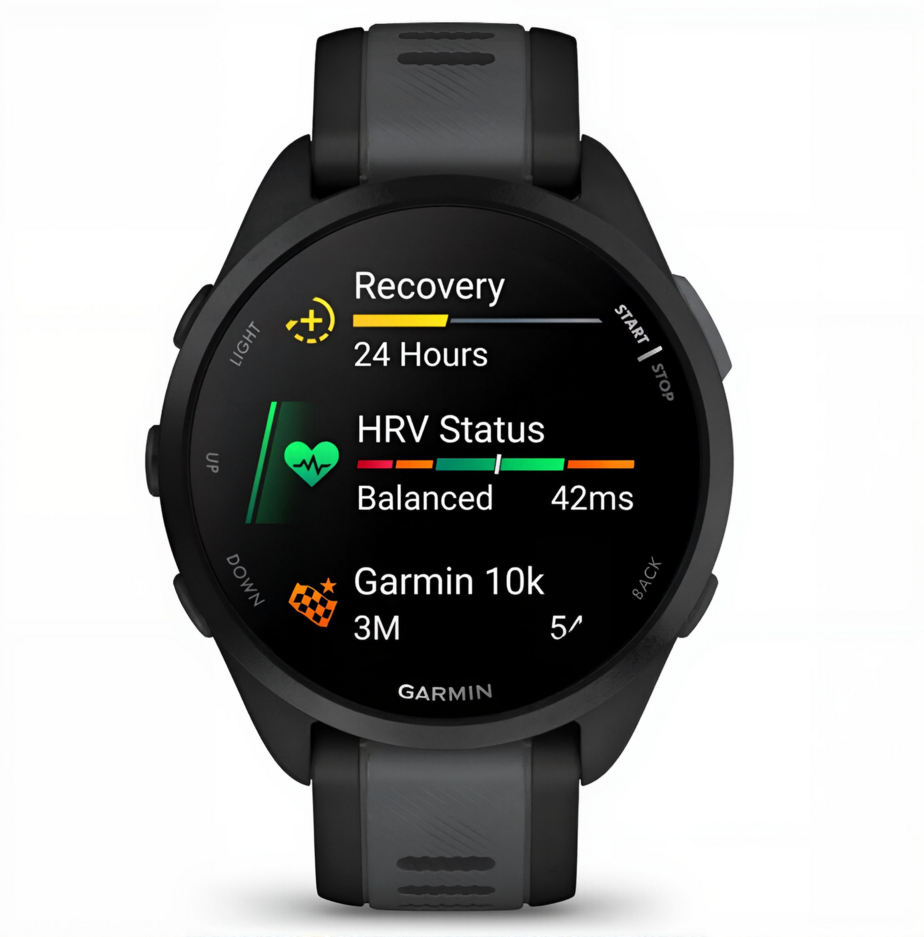
Why the Display Matters:
✅ Crystal clear in bright sunlight – Actually readable at high noon
✅ Text messages readable – First Garmin where I can actually read incoming texts
✅ Always-on capability – Without destroying battery (more on that later)
✅ Watch faces look premium – Finally doesn’t feel like a basic training device
The Features: All the Essentials, None of the Bloat
For me, the best part is the price. For a runner who is taking training seriously, the 165 hits a sweet spot, providing all the necessary recovery stats and metrics you really need.
Recovery Metrics That Actually Matter:
✅ Body Battery – Energy levels based on sleep, stress, activity
✅ Sleep Score – Detailed breakdown of sleep quality
✅ Resting Heart Rate – Daily baseline monitoring
✅ HRV Status – Heart rate variability for recovery assessment
✅ Training Effect – Cardiovascular benefit measurement
✅ VO2 Max Estimate – Aerobic fitness tracking
Running-Specific Features:
✅ GPS tracking – Single-frequency (accurate enough)
✅ Running Dynamics – Cadence, stride length, ground contact
✅ Daily Suggested Workouts – Personalized training recommendations
✅ Race Widget – Goal-focused adaptive training
✅ PacePro – Elevation-adjusted race pacing
✅ Elevation data – The FR 165 does not have a barometric altimeter, so it estimates elevation using GPS data alone.
✅ Quick GPS acquisition – Locks on satellites fast
What’s Missing (And Why I Don’t Care):
❌ Dual-frequency GPS (overkill for 99% of runners)
❌ Multiband GPS (adds weight, drains battery faster)
❌ Music storage (phone works fine)
❌ Advanced health metrics (SpO2, ECG)
For marathon training, this watch gives me exactly what I need: training insights that improve performance without the complexity.
Accuracy: How Does It Actually Track?

GPS Accuracy:
The Forerunner 165 uses single-frequency GPS (older tech than the 265’s dual-frequency). In real-world testing:
✅ Road runs: Dead accurate (±0.05% variance)
✅ Trail runs: Minor drift in dense forest (expected with single-frequency)
✅ Satellite acquisition: Locks on in 15-30 seconds (quick for this class)
Compared to my old 955 with dual-frequency GPS? Negligible difference for marathon training distances.

Heart Rate Accuracy:
✅ Road runs: Dead accurate (±0.05% variance)
✅ Trail runs: Minor drift in dense forest (expected with single-frequency)
✅ Satellite acquisition: Locks on in 15-30 seconds (quick for this class)
Compared to my old 955 with dual-frequency GPS? Negligible difference for marathon training distances.
Heart Rate Accuracy:
The Garmin Elevate V4 sensor (last-gen tech) performs surprisingly well:
✅ Consistent HR reading – Matches chest strap 95% of the time
✅ Recovery tracking reliable – Resting HR trends are accurate
✅ Alert accuracy – HRV and stress readings feel validated
The Size and Weight: Perfect for Runners
One detail I hadn’t expected to love: the size.
At 43 x 43 x 11.6mm and 39g, this watch is noticeably smaller than my old 955. On paper, 3-4 grams doesn’t sound like much. But after 20 miles, you feel it.
Real experience: It feels like the watch isn’t any bigger than it needs to be, which is perfect.
This is a watch designed for runners, not mountaineers.
The Price: Why It Matters.
t $299 MSRP, the Forerunner 165 is positioned perfectly:
vs. Forerunner 55 ($199): Adds AMOLED + recovery metrics. Worth $100 difference.
vs. Forerunner 265 ($399): You lose dual-frequency GPS + music. Save $100.
vs. Forerunner 965 ($600): You lose advanced health tracking. Save $300.
For a serious marathoner, the 165 is the value leader.
Garmin Support: Why I’m a Loyal Customer
This deserves its own section because it matters more than specs.
When my Forerunner 955 broke outside warranty, I expected to pay $300-400 for repair or replacement.
Garmin sent me a free refurbished replacement from their stock.
That’s the kind of customer service that creates loyalty. When gear breaks, the company standing behind it matters more than the specs.
Comparison Table: Forerunner 165 vs. Competitors
| Feature | Forerunner 165 | Forerunner 55 | Forerunner 265 | Forerunner 965 |
|---|---|---|---|---|
| Display | AMOLED (color) | MIP (monochrome) | AMOLED (color) | AMOLED (color) |
| Price | $299 | $199 | $399 | $599 |
| Battery (GPS) | 19 hours | 20 hours | 20 hours | 21 hours |
| GPS Type | Single-freq | Single-freq | Dual-freq | Dual-freq |
| Body Battery | Advanced | Basic | Advanced | Advanced |
| Sleep Tracking | Advanced | Basic | Advanced | Advanced |
| VO2 Max | Yes | Yes | Yes | Yes |
| Training Effect | Yes | No | Yes | Yes |
| Running Dynamics | Yes | No | Yes | Yes |
| Music Storage | No | No | No | Yes |
| Best For | Marathon training | Casual running | Serious athletes | Pro athletes |
Who Should Buy This Watch?
Perfect For:
✅ Serious marathoners & ultramarathoners
✅ Triathlon trainers
✅ Runners who want recovery metrics without premium pricing
✅ Anyone upgrading from older Garmin watches
✅ Budget-conscious runners taking training seriously
Not Ideal For:
❌ Casual joggers (overkill features, unnecessary cost)
❌ Ultrarunners doing 24+ hour efforts (consider higher battery option)
❌ Athletes needing ECG or advanced health metrics
❌ Runners prioritizing music storage
The Downsides (Honest Assessment)
No watch is perfect. Here are the real compromises:
1. Battery life compromise – AMOLED burns battery faster than MIP
2. Single-frequency GPS – Not as robust as dual-frequency in dense forest
3. No music storage – Purely for training, not for listening
4. Limited health tracking – No ECG, no advanced blood oxygen monitoring
5. Requires Garmin ecosystem – Better experience with Garmin Connect app
These are acceptable trade-offs for most runners, but worth knowing upfront.
Final Verdict: The Best Value Running Watch 2025
The Garmin Forerunner 165 is what happens when a company optimizes for what runners actually need.
It has the recovery metrics to improve training. It has the GPS accuracy for races. It has the display that makes you want to wear it. And it costs less than the alternatives.
For a serious marathoner or triathlete, this is the watch to buy.
Not because it’s perfect. But because the value is undeniable.
I went from expecting to spend $500+ to finding myself genuinely happy with a $299 device. That doesn’t happen often.
Bottom Line: If you’re serious about running training but tired of premium pricing, the Garmin Forerunner 165 is exactly what you’re looking for.