7 Best Running Socks for Long Runs and Marathons (2026)
Long-run comfort, marathon fit and fewer late-mile surprises
Quick answer: The Feetures Elite Light Cushion Tab is a good starting point for most long run shoes because it balances a close fit, light padding and a secure heel tab. Choose the Balega Enduro Quarter if your shoe has room for more cushion, the Injinji Run Lightweight if your toes rub together, or the Swiftwick Aspire if your race shoe already feels snug.
A marathon sock should disappear on your foot. The right choice is not always the softest sock in the store. It is the one that still fits when your feet are warm, damp and slightly swollen late in a long run.
Shop the best socks for long runs and marathons
Swipe on a phone. Start with one pair, test it in your marathon shoes, and only then buy more colours or a multi-pack.
Best overall · researched

Feetures Elite Light Cushion Tab
Light padding, a close anatomical fit and targeted arch compression make this the easiest all-around recommendation.
Best cushioned · brand experience

Balega Enduro Quarter
Medium cushion and a deep heel pocket suit runners who want a softer long run feel without a loose sock.
Best for toe rubbing · Justin owns it

Injinji Run Lightweight No Show
Each toe gets its own sleeve, removing skin-on-skin contact where toe blisters often start.
Best thin race sock · researched

Swiftwick Aspire Ankle
An ultra thin sock with firm compression for hot races and shoes that cannot spare extra volume.
Best for mixed weather · brand experience

Darn Tough Run Quarter Cushion
A thin merino blend, quarter cuff and lifetime guarantee make this a useful wet or changeable-weather option.
Best double layer · researched

Wrightsock CoolMesh II Crew
Two thin connected layers of fabric. Designed to prevent rubbing.
Best value rotation · researched
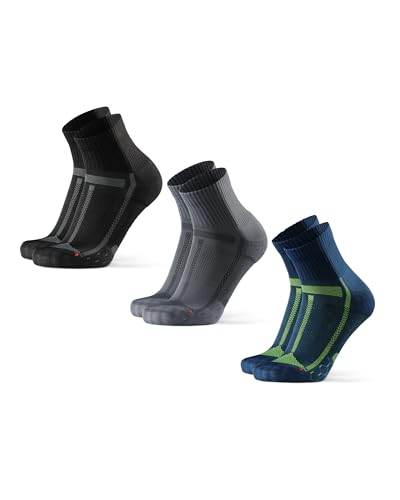
Danish Endurance Long Distance 3-Pack
A three-pair synthetic rotation with cushioning, arch compression and cooling channels for a busy training week.
Affiliate disclosure: As an Amazon Associate, Running Gear Lab earns from qualifying purchases. This costs you nothing extra. Affiliate availability did not decide the order of the picks, and we do not show prices because they can change.
Full reviews: best marathon and long-run socks
1. Best overall for most long runs
Feetures Elite Light Cushion Tab
Research pick: exact model not personally tested by our team
Best for: Runners who want one secure, low-bulk sock for training runs and marathon day.
Feetures earns the top spot because it sits between two common extremes. It has enough high-density cushion to soften contact without the plush volume of a thick sock. The left/right shape, targeted arch compression and seamless toe are all meant to keep the fabric close to the foot rather than allowing it to wrinkle.
That balance makes sense for a marathon. Your feet can expand as time and heat build, so leaving some room in the shoe matters. The heel tab also protects the back of the ankle without adding a tall cuff.
Bottom line: If you do not yet know whether you prefer thin or plush socks, this is the most sensible middle ground. Buy one pair first and test the arch pressure after an hour.
Amazon link opens a multi-pair listing. Confirm pack size, colour and sock size before ordering.
2. Best cushioned long-run sock
Balega Enduro Quarter
Brand experience: Justin owns Balega Blister Resist, not this exact Enduro model
Best for: Easy long runs, tired feet and shoes with enough room for medium cushion.
The Enduro Quarter is the comfort-first choice. Balega uses a deep heel pocket, a roomy toe area, seamless construction, mesh panels and its V-Tech arch structure. The medium cushioning can make a firm daily trainer feel friendlier late in a long run.
More cushion also uses more space. If your shoe is already close across the forefoot, the same softness can turn into pressure when your feet swell. Try the Enduro in the exact shoe you plan to race in, not just around the house.
Bottom line: Choose the Enduro when comfort matters more than minimum weight. If you are between this and Swiftwick, let shoe volume decide.
3. Best for blisters between the toes
Injinji Run Lightweight No Show
Direct experience: Justin owns and runs in this exact model
Best for: Runners whose toes rub each other or who develop blisters between the toes.
Injinji solves a specific problem that a normal sock cannot: skin-on-skin rubbing between toes. Each toe is wrapped separately, so damp toes are not repeatedly pressed and rubbed together. Justin uses the exact Run Lightweight No Show, and it is also part of his broader blister-prevention setup.
The unusual shape is not automatically better for everyone. It takes longer to put on, and the toe sleeves must sit smoothly. A cramped toe box can still create pressure. Some runners also report that lightweight toe socks wear through sooner than their conventional socks, so check the fabric around the big toe before race day.
Bottom line: This is our most targeted pick, not the universal winner. When toe-to-toe friction is the problem, its design makes more sense than simply buying a thicker conventional sock.
For tape, lubricant and hot-spot options, see our runner-tested blister prevention guide.
4. Best thin sock for hot marathons
Swiftwick Aspire Ankle
Research pick: exact model not personally tested by our team
Best for: Hot races, swollen feet and close-fitting carbon-plated shoes.
The Aspire is the sock to try when every millimetre of shoe volume matters. Swiftwick gives it an ultra-thin profile, firm contoured compression, a Y-shaped heel and a channelled upper for airflow. The higher ankle cuff also offers a little more protection than a hidden sock.
Minimum cushion is not a badge of seriousness. It simply changes how your shoe fits. Some runners love the direct feel and firm hold; others feel pressure from the compression or want more protection under the forefoot.
Bottom line: Pick the Aspire to preserve space in a snug race shoe, not because thin socks are always faster.
Confirm whether the selected Amazon variation is one pair or a multi-pack.
5. Best for wet and changing weather
Darn Tough Run Quarter Cushioned Ultra-Lightweight
Brand experience: Justin owns Darn Tough crew socks, not this exact Run Quarter
Best for: Cool starts, light rain, trail debris and runners who value a lifetime guarantee.
This Darn Tough model combines low-bulk yarn with cushioning and a quarter cuff. The brand says the performance fit is designed to resist slipping and bunching, while merino helps move heat and moisture away from the foot. The cuff adds coverage when gravel, rain or trail dust would annoy a no-show sock.
Merino is not magic and this is not a heavy winter sock. Its advantage is versatility across changing temperatures rather than maximum warmth. Darn Tough’s unconditional lifetime guarantee adds value for runners who keep socks for years.
Bottom line: A versatile choice for runners who do not want separate socks for every mild weather change. For deep cold, wait for our dedicated winter sock guide.
6. Best double-layer sock for repeated hot spots
Wrightsock CoolMesh II Crew
Research pick: exact model not personally tested by our team
Best for: Runners who repeatedly feel a hot spot at the heel or forefoot and want a connected two-layer system.
Wrightsock connects an inner and outer layer so movement can occur between fabrics instead of concentrating against the skin. It is a tidy alternative to wearing two unrelated socks, which can crease or take up too much space.
There is an important evidence caveat. A 2024 critical review found that real-world evidence for double-sock systems is mixed. That does not mean the CoolMesh II cannot help an individual runner. It means no sock should be sold as a blister guarantee for every foot and shoe.
Bottom line: A reasonable experiment for a repeat hot spot, but not the first pick for a shoe that already fits tightly.
7. Best value training rotation
Danish Endurance Long Distance Running Socks
Research pick: exact model not personally tested by our team
Best for: Marathon training weeks when you want three purpose-built pairs without buying seven premium singles.
Danish Endurance offers the easiest way to build a training rotation from this list. The quarter sock uses a lightweight synthetic blend, cooling channels, targeted cushioning and arch compression. The brand also lists an OEKO-TEX Standard 100 certification and a one-year hole-free guarantee.
The value is in having clean technical socks ready for several runs, not in pretending this pack has the most precise fit. Feetures has a left/right shape, Injinji separates the toes and Swiftwick offers a notably firm hold. Danish Endurance is the practical generalist.
Bottom line: The best value is a sock you can train in consistently. Use one pair for a long run before committing the whole pack to race duty.
Long-distance running sock comparison
The table focuses on shoe fit and late-mile comfort. “Thin” is not automatically better, and “cushioned” is not automatically safer.
| Sock | Best for | Underfoot feel | Height | Fit feel | Conditions | Main tradeoff |
|---|---|---|---|---|---|---|
| Feetures Elite Light | Most runners | Light cushion | No-show tab | Close, shaped, supportive | Road training and racing | Arch compression can feel firm |
| Balega Enduro | Soft long-run comfort | Medium cushion | Quarter | Secure heel, forgiving toe box | Daily long runs | Can crowd a close race shoe |
| Injinji Run Lightweight | Toe-to-toe rubbing | Lightweight | No-show tab | Individual toe sleeves | Warm road or trail miles | Slower to put on; toe fit is personal |
| Swiftwick Aspire | Snug shoes and heat | Minimum cushion | Ankle | Firm compression | Hot races and speed shoes | Too firm or bare for some runners |
| Darn Tough Run Quarter | Mixed weather | Ultra-light with cushion | Quarter | Performance fit | Cool, wet or changeable runs | Not the plushest choice |
| Wrightsock CoolMesh II | Repeated hot spots | Two light layers | Crew | More fabric, little inner movement | Road, walking and mixed use | Warmer and bulkier than one layer |
| Danish Endurance Long Distance | Training rotation value | Cushioned | Quarter | Arch compression | Weekly training mileage | Less precise fit than left/right socks |
On a phone, swipe the table sideways. The first column stays visible.
Why these seven made the list
We began with the problems that appear on long runs: toes rubbing, socks shifting, moisture building, feet swelling and a cushioned sock stealing too much shoe volume. Then we checked manufacturer specifications, warranty terms, specialist running-store guides and recurring comments in running forums.
Forum comments helped us find patterns, not declare a winner. Runners repeatedly praise Feetures and Swiftwick for a locked-in fit, Balega for softness, and Injinji for toe blisters. They also disagree. Some runners find Balega too plush, Feetures too compressive or double-layer socks too warm. That disagreement is useful because sock choice depends heavily on the shoe and the runner’s foot.
We did not award pretend scores or copy Amazon star ratings. A high rating cannot tell you whether a sock will crowd your marathon shoe.
The six-step marathon sock test
Do not let race morning be the first time a sock meets your marathon shoe. This short progression catches most fit problems while there is still time to change.
One-pair rule: Buy one pair first when it is available as a single. Once it survives two long runs in your marathon shoe, buying two or three identical pairs makes sense. If the Amazon listing is only a multi-pack, try a single pair from a local running store or the brand first.
What actually changes on a long run?
Feet warm up and take more space
A sock that fills the shoe perfectly at kilometre one can feel thick later. If the upper presses across your forefoot or your toes lose room, try a thinner sock before assuming you need more cushion.
Moisture changes the skin and fabric
Sweat and rain affect friction, drying time and comfort. Modern synthetic and merino-blend socks are built to move moisture, but none keeps a flooded shoe dry. Cotton holds water and dries slowly, which is why it is rarely a good marathon choice.
Small folds become large problems
A tiny wrinkle or loose heel can create repeated pressure thousands of times. The clinical blister literature identifies shear, pressure and repeated cycles as important parts of the problem. Smooth construction and secure fit matter more than marketing words alone.
The shoe and sock behave as one system
Changing sock thickness changes shoe volume. If your toes hit the front, your heel lifts or your forefoot spills over the platform, visit the running shoe finder and solve the larger fit issue.
No sock can promise zero blisters. A 2024 critical review found that many popular blister-prevention methods have limited or mixed real-world evidence. Familiar footwear, a smooth sock fit, early hot-spot action and enough shoe room still matter. Seek medical advice for infected, severe or repeatedly unexplained skin problems.
Build the rest of your long-run kit
Frequently asked questions
What are the best socks for long runs?
Feetures Elite Light Cushion is the best starting point for most runners because it balances light padding, low bulk and a secure anatomical fit. The better answer changes with the problem: choose Injinji for toe rubbing, Balega Enduro for more cushion, Swiftwick Aspire for a snug shoe, Darn Tough for mixed weather, or Wrightsock for a recurring hot spot.
Should marathon socks be thick or thin?
They should match the available space in your shoe. A thin sock can protect toe room as feet swell, while a cushioned sock can feel better in a roomier shoe. Neither thickness is universally safer. Test the exact sock and marathon shoe together on a long run.
Are toe socks good for marathons?
Toe socks can be especially useful when toes rub together or blisters form between them. They separate each toe, but they take longer to put on and may feel crowded in a narrow toe box. They should be tested well before race day.
Why should runners avoid cotton socks for a marathon?
Cotton absorbs moisture and dries slowly. A 2024 review of blister-prevention research notes that cotton is hydrophilic and can take much longer to dry than synthetic fibres. A technical synthetic or merino blend is usually a better long-distance choice.
Should I wear two pairs of socks to prevent blisters?
A connected double-layer sock such as Wrightsock may help some runners, but research on double-sock systems has shown mixed results. Two unrelated socks can also add bulk or wrinkles. Test the system in your actual shoe and stop if it creates pressure or heat.
Can I wear new socks on marathon day?
It is safer to race in a clean pair that has already been washed and used successfully with the same shoes. A new sock can fit, compress or rub differently than expected. Give it at least one long-run test first.
Do compression socks improve marathon performance?
Some runners like a supported feel, but compression is not a guaranteed performance boost. For this guide, compression matters mainly because it changes fit. If firm arch pressure feels uncomfortable or leaves marks, choose a less compressive sock.
When should running socks be replaced?
Replace a sock when padding is flattened, the heel or toe becomes thin, elastic no longer holds it in place, or a seam or wrinkle begins to create a hot spot. Inspect race socks several weeks before the event so there is time to test a replacement.
Sources checked
We used official product specifications for construction and fit claims, specialist running guides for category coverage, forum discussions for recurring user themes, and peer-reviewed research for the blister evidence caveat. Forum experiences are subjective and were not treated as product tests.
- Feetures Elite Light Cushion Tab product page
- Balega Enduro Quarter product page
- Injinji Run Lightweight No Show product page
- Swiftwick Aspire Ankle product page
- Darn Tough Run Quarter product page
- Wrightsock CoolMesh II Crew product page
- Danish Endurance Long Distance Quarter product page
- Friction Blisters of the Feet: A Critical Assessment of Current Prevention Strategies
- r/AdvancedRunning discussion: long-run socks
- r/XXRunning discussion: sock fit and preference
- RunToTheFinish running sock guide
- Footwind long-distance running sock guide
- Running Warehouse running sock guide
Written by Kelly Hanna with clearly labelled gear experience from Justin Evenden. Product details and links last checked October 26, 2026.